AI agents vs. AI assistants
An AI assistant responds to a request and produces an answer or a draft for you to use, while an AI agent takes a goal and works through the steps to reach it on its own, looping a person in along the way.
Introduction to AI agents and AI assistants
Both an AI assistant and an AI agent are usually built on the same kind of large language model, and both can sit behind a chat box, which is why the two are easy to confuse and are often used interchangeably. The difference is what happens after you ask.
A short way to hold it is that an assistant informs while an agent acts. An assistant completes the request you gave it and waits for the next one. An agent takes a goal, works out the steps, and carries them out, returning to you for input or approval rather than for the next instruction. Ask an assistant to help with a payment run and it might summarise which payments need attention; give the same goal to an agent and it assembles the run, checks each payment against your rules, flags the exceptions, and presents the result ready to approve.
The line is not always crisp. Many real products combine both, answering questions on request and running agentic tasks when given a goal, and the labels are applied loosely in the market, with reactive tools sometimes marketed as agents. The useful question is rarely which label a product wears, but how much it decides and does on its own, which is the property covered under agentic AI.
How they differ
Beyond the headline distinction, a few specific differences tend to separate the two.
- What sets it off: an assistant is triggered by your prompt; an agent is set in motion by a goal and can begin work on its own or on a schedule.
- Inform or execute: an assistant produces output you then act on, such as an answer, a summary, or a draft; an agent completes the steps itself, acting through tools across one or more systems.
- Scope: an assistant handles one task at a time; an agent works through a multi-step process and decides the order of the steps.
- Memory: an assistant often starts fresh each session, so you re-supply context; an agent tends to hold context across the steps of a task, and sometimes across sessions.
Choosing between them
Neither is better in general; they fit different work. An assistant suits open-ended, one-off tasks where you want to stay in the driver's seat: drafting, summarising, answering a question, exploring an idea. It is quick to adopt, predictable, and keeps you in direct control of each step.
An agent earns its place when a task is repetitive, runs to a defined goal, and spans multiple steps or systems that you would otherwise stitch together by hand. That capability comes at a cost: an agent is more involved to set up, harder to make fully predictable, and needs guardrails around what it can do on its own, which is why oversight matters more as autonomy rises.
Agents and assistants in finance
In finance, the two tend to play complementary roles. An assistant is useful for asking questions of your data, such as checking a balance or pulling a figure, and for drafting on request. An agent is suited to the recurring operational work that runs to a schedule, such as assembling a daily position or reviewing a payment run, where it can prepare the output and surface what needs attention. In both cases a person approves anything that moves money, which is how AI agents in treasury are typically run.
How Atlar uses AI agents and an assistant
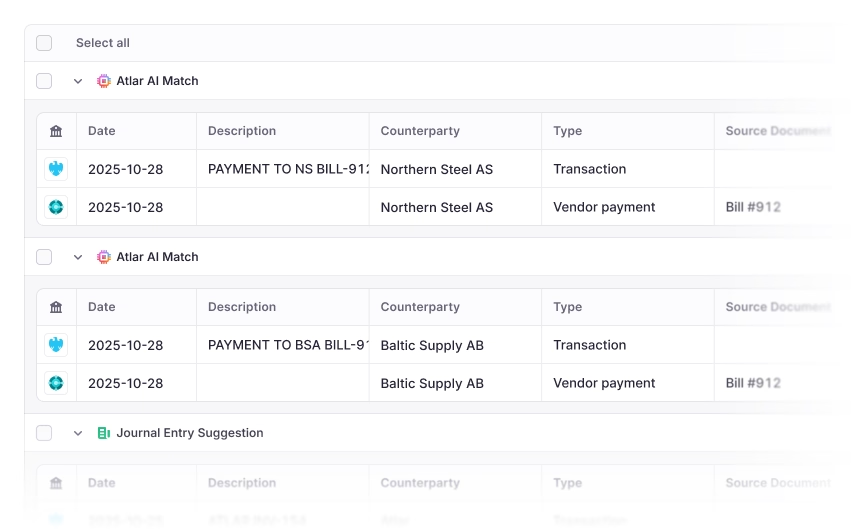
Atlar provides an AI assistant you can ask and AI agents that do the work. The assistant answers questions of your live treasury data, querying balances, flows, and transactions and explaining what is driving them, while the agents take on recurring work, assembling the daily cash position or surfacing payment anomalies before anyone asks, and presenting the result for you to review. The connections to your banks and ERP are built and managed by Atlar, so both work from current balances and transactions rather than exported or stale figures.
Access is governed by your existing user permissions and role-based controls, and you can reach the same data from inside Claude.
Companies like Lovable and Trustly run their treasury on Atlar, the top-rated treasury platform on G2, rated 4.8 on average across 60+ reviews. To see how Atlar's AI works, see Atlar Intelligence, or book a demo with our team.
You can unsubscribe anytime.
Further reading
See Atlar in action.
Enter your work email to watch a live product demo.