ISO 20022 files
ISO 20022 files are standardized XML-based message formats used by banks and financial institutions to exchange payment and account information consistently across global systems.
Introduction to ISO 20022
ISO 20022 is an international messaging standard developed to improve how financial institutions exchange data. It provides a common language and structure for payments, account statements, and other financial messages, ensuring that information moves accurately between banks, corporates, and market infrastructures.
Unlike older formats that vary by country or bank, ISO 20022 uses a universal data model and extensible XML structure. This makes it easier to include detailed, structured information in every message, improving automation, reconciliation, and reporting across all systems involved in a transaction.
How ISO 20022 files work
Each ISO 20022 file contains structured data organized into specific message types, such as:
- PAIN.001: Payment initiation messages sent by corporates to banks.
- CAMT.053: Account statement messages that provide detailed transaction data.
- PACS messages: Interbank payment instructions and confirmations.
The “ISO 20022” standard defines not just the message formats but also the syntax, data fields, and rules that make them interoperable across financial systems. These files are written in XML (Extensible Markup Language), which uses structured tags to describe each piece of information — for example, payment amount, currency, or settlement date.
This structure allows systems to interpret and process data automatically, minimizing manual intervention and reducing the risk of errors.
Understanding CAMT.052, CAMT.053, and CAMT.054
The CAMT (Cash Management) message family within ISO 20022 provides standardized reporting on account activity. The three most common CAMT files differ by purpose and level of detail:
- CAMT.052 – intraday report: Provides same-day reporting of account activity, showing transactions as they occur. Used for real-time or intraday cash visibility.
- CAMT.053 – end-of-day statement: Summarizes all transactions for a given day, equivalent to a traditional bank statement.
- CAMT.054 – payment advice or notification: Lists individual credit or debit entries as they are booked, often used to confirm specific payments or collections.
Why ISO 20022 matters
ISO 20022 is becoming the global standard for financial messaging because it offers richer, more structured data than legacy formats. This enhanced data quality improves straight-through processing (STP), reduces exceptions, and supports faster reconciliation.
For treasury teams, the benefits include:
- Improved data accuracy: Standardized tags reduce ambiguity in transaction details.
- Enhanced reporting: Detailed fields enable clearer analysis of payments and balances.
- Automation and efficiency: Consistent formatting supports automatic data imports across systems.
- Global consistency: A single standard simplifies multi-bank, multi-region connectivity.
As banks worldwide adopt ISO 20022, corporates benefit from greater interoperability and transparency in how payments and balances are communicated.
ISO 20022 vs. legacy formats
Legacy formats like BAI2 and MT940 have long been used for electronic bank statements and cash reporting. However, these formats use fixed text or comma-separated layouts with limited data capacity. ISO 20022, by contrast, uses flexible XML structures that can carry much more information in a consistent, machine-readable form.
For example:
- A BAI2 file lists transactions as coded text lines.
- An ISO 20022 file can include detailed references, counterparties, and remittance information for each transaction.
This richer data supports advanced reconciliation and analytics, allowing treasurers to connect transaction details directly to invoices, customers, or internal systems with minimal manual effort.
ISO 20022 in treasury operations
For finance and treasury teams, ISO 20022 enables more accurate and timely visibility across global bank accounts. Many modern treasury management systems and ERP platforms now rely on ISO 20022 files for bank reporting, reconciliation, and forecasting.
With consistent file formats across banks, companies can automate processes that once required manual adjustments or custom integrations. This standardization simplifies multi-bank connectivity, improves data reliability, and enhances liquidity control across entities and currencies.
How Atlar centralizes bank data across accounts and markets
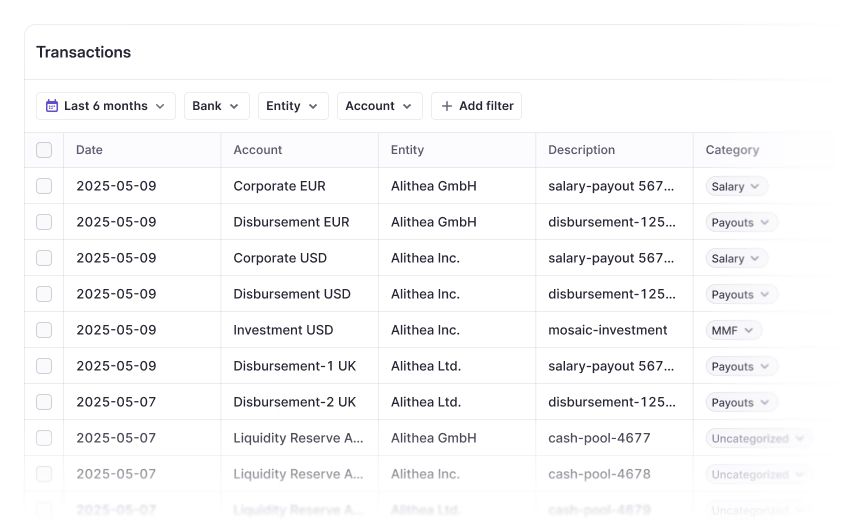
Atlar connects to banks and payment service providers to retrieve account balances and transaction data across all connected accounts. This information is standardized within the platform, giving finance teams a unified view of balances and transactions across banks, entities, and markets.
By centralizing bank data in one place, Atlar removes the need for manual downloads, file handling, and reconciliation across multiple banking portals. Finance teams can work from a single, consistent data set, improving visibility, control, and day-to-day efficiency across their treasury and accounting workflows.
Interested in learning more? Book a demo with our team.
You can unsubscribe anytime.
Further reading
See Atlar in action.
Enter your work email to watch a live product demo.