What is AI-native treasury?
AI-native treasury is a treasury platform built with AI at the center of its design, where the data model and workflows are shaped around AI from the start rather than added afterwards.
Introduction to AI-native treasury
AI-native refers to how a platform is built. In an AI-native system, AI works directly on the platform's live data and the workflows are designed around it. In an AI-enabled or bolt-on system, AI is added to a product that was designed before it, usually as a feature such as a chat window or a separate service beside the main tool.
In treasury, that means an AI-native platform was built so AI could work across the bank and ERP connections, the consolidated data, and the operational workflows from the outset. Since almost every platform now has some AI, the useful question is how deeply it is wired in.
The label is easy to claim and hard to verify. A platform can call an external model from inside an otherwise unchanged system and still describe itself as AI-native. What tells you more is whether the AI reaches live data, sits inside the everyday workflow, and actually changes how the work gets done.
What makes a platform AI-native
A few architectural markers tend to separate an AI-native platform from one with AI added on.
- Shared data: the AI reads and reasons over the platform's own live records directly, with no copy exported to a separate model, so it always sees the current state without a batch handoff.
- AI in the workflow: AI is available at the point where the work happens, built into the operational flow so it is there as you work.
- Built around agents: the workflows assume AI can act, often as agentic AI that carries out steps, so intelligence is part of the process design.
- Feedback and adaptation: the system is designed for models and data to change continuously, so outcomes feed back into later decisions.
None of this makes AI-native automatically the right choice. Building around AI is more involved than adding a feature, and a bolt-on assistant can be a sensible, lower-cost way to bring AI to an established system. What AI-native changes is how far AI reaches into the work, which matters most where the AI needs current data and a place inside the everyday workflow to be useful.
Why the data model matters in treasury
The reason the architecture matters in treasury comes back to data. Treasury data is spread across banks, payment systems, and ERPs, and much of the value of AI depends on working from a single, current picture of it. A platform built to consolidate that data, through direct bank connectivity and ERP integration, gives AI a live source to reason over from the outset. Where that foundation is missing, AI has to reach the data indirectly, which reintroduces the lag and fragmentation it was meant to resolve. This is why the AI-native question in treasury is really a question about the data foundation, and it sits within the wider picture of AI in treasury management.
How Atlar approaches AI-native treasury
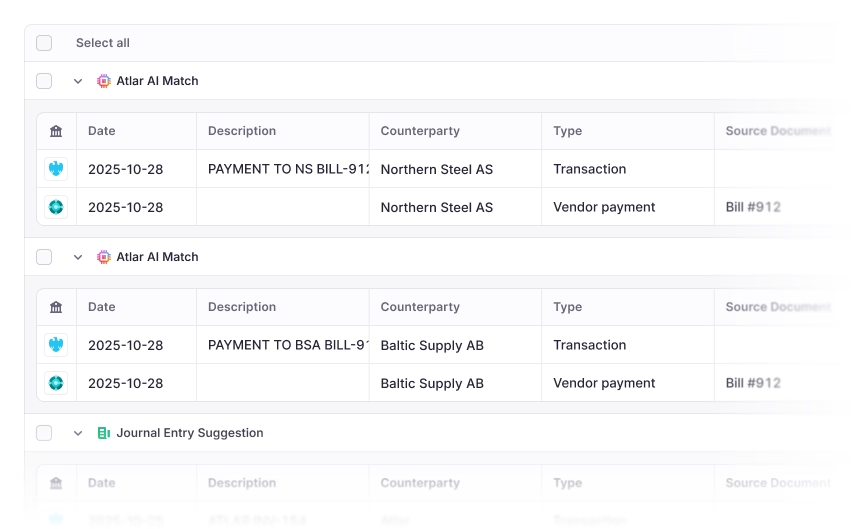
Atlar was built as an AI-native treasury platform, with the connectivity and data layer designed for the AI from the ground up. Atlar builds and manages the connections to your banks and ERP, consolidating balances and transactions in real time. Its AI agents and assistant work from that live data rather than exported or stale figures. It is the approach that led companies like Lovable and Trustly to choose Atlar.
The agents take on recurring operational work and present their output for you to review, across cash positioning, payments, reconciliation, and forecasting. Access is governed by your existing user permissions and role-based controls, and your team reviews and approves the output before anything happens, including from inside Claude. Atlar is also the top-rated treasury platform on G2, rated 4.8 on average across 60+ reviews.
To see how Atlar's AI works, see Atlar Intelligence, or book a demo with our team.
You can unsubscribe anytime.
Further reading
See Atlar in action.
Enter your work email to watch a live product demo.