What is cash flow?
Cash flow is the movement of money into and out of a business over a period of time, showing how much cash it generates and how much it spends.
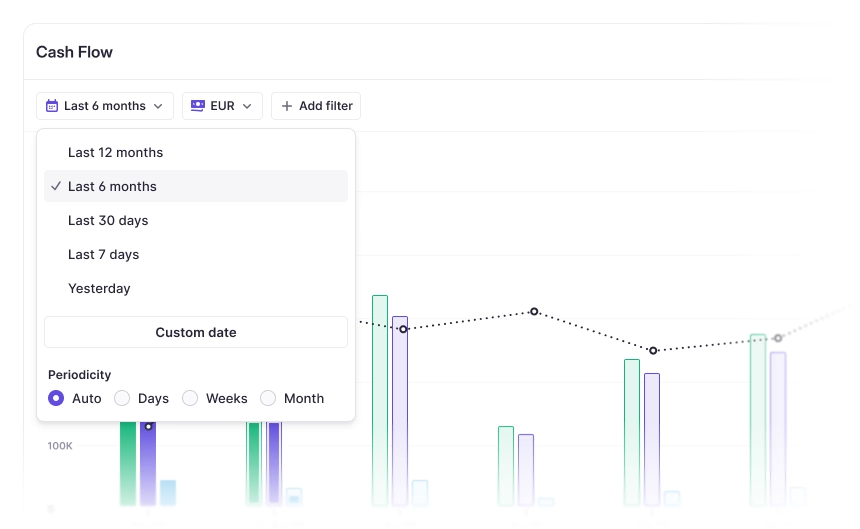
Introduction to cash flow
Cash flow is the money coming into and going out of a business across a given period, such as a month, quarter, or year. Money comes in from sources like sales, financing, and returns on investments, and goes out on costs like salaries, supplier payments, taxes, and loan repayments. The difference between the two over the period is the company's net cash flow.
Cash flow is one of the clearest indicators of financial health. A business can look profitable on paper and still run out of cash if money is tied up in unpaid invoices or inventory, so tracking the actual movement of cash matters alongside tracking profit. Positive cash flow means more money came in than went out over the period, giving the business funds to cover its obligations and invest in growth. Negative cash flow means the reverse, which can be a warning sign or, for a growing company, a sign of heavy investment.
Cash flow is measured across three types of activity, each answering a different question about where the money came from and where it went.
The three types of cash flow
A company's total cash flow is made up of three categories. Together they account for every cash movement in the business over the period.
- Operating cash flow: the cash generated and used by the core business, such as receipts from customers and payments to suppliers and staff.
- Investing cash flow: the cash spent on and received from long-term assets, such as buying equipment or property, or selling them.
- Financing cash flow: the cash raised from and returned to investors and lenders, such as issuing shares, drawing or repaying debt, and paying dividends.
These three categories are the structure of the cash flow statement, the financial statement that reports cash movement over a period. Adding the three together gives the net change in the company's cash for the period.
Cash inflows and outflows
At its simplest, cash flow is the balance of inflows against outflows. Inflows are any money entering the business: customer payments, loan proceeds, equity investment, interest earned, and proceeds from selling assets. Outflows are any money leaving it: salaries, rent, supplier and tax payments, loan repayments, and capital purchases.
The timing of these movements matters as much as their size. A sale recorded today may not become a cash inflow for 30 or 60 days, and a cost committed now may leave the account later. This gap between when a transaction is recorded and when the cash actually moves is a central reason cash flow and profit can diverge in any given period. For how money moves through a company's accounts in practice, see flow of funds.
Cash flow and profit
Cash flow and profit measure different things. Profit is revenue minus expenses under accrual accounting, which records income and costs when they are earned or incurred rather than when cash changes hands. Cash flow tracks the money that actually moves. A company can report a profit while cash falls, for example when sales are made on credit and the cash has not yet arrived, or when it is investing heavily in inventory and equipment.
This is why cash flow is often described as the more reliable near-term measure of whether a business can meet its obligations. Profit shows performance over the period; cash flow shows whether there is money in the bank to pay for it.
Why cash flow matters
Understanding cash flow underpins most financial decisions a business makes.
- Meeting obligations: knowing cash flow tells you whether there is enough money to cover payroll, suppliers, and debt as they come due.
- Planning ahead: projecting future inflows and outflows lets a business anticipate shortfalls and surpluses before they happen. This forward-looking view is the job of cash flow forecasting.
- Assessing the present: reviewing past inflows and outflows establishes where the business stands now, the basis of cash positioning and cash flow analysis.
- Managing working capital: cash flow is closely tied to how efficiently a company manages receivables, payables, and inventory, the focus of working capital management.
How Atlar can help with cash flow
Atlar helps you understand your cash better and save hours every month by managing cash in a single platform that syncs with all your banks and ERP. You can track cash positions in real time, analyze your cash flow over any time horizon, and create forecasts with accurate data.
By consolidating balances and transactions from every connected bank, PSP, and ERP into one view, Atlar gives finance and treasury teams one accurate, real-time view of their cash. Customers including Acne Studios, GetYourGuide, and Upvest use Atlar to see their cash across all accounts, currencies, and entities without manual file transfers or logging into multiple portals.
To learn more, explore our cash management solution or book a demo with our team.
You can unsubscribe anytime.
Further reading
See Atlar in action.
Enter your work email to watch a live product demo.