What is operating cash flow?
Operating cash flow is the cash a company generates from its core business operations over a period, before investing and financing activities.
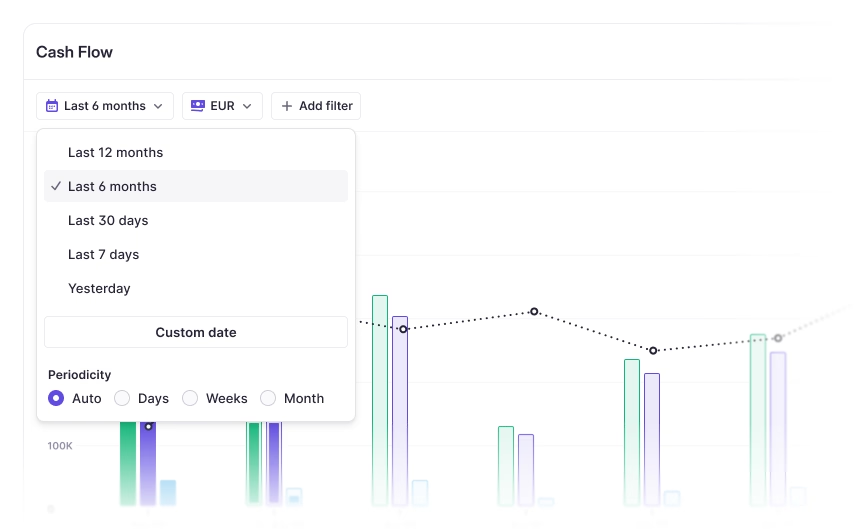
Introduction to operating cash flow
Operating cash flow (OCF) is the cash produced by a company's day-to-day operations, the activity of selling its products or services and paying the costs of doing so. It captures receipts from customers and payments to suppliers, employees, and for operating expenses and taxes, and it excludes cash from investing and financing.
It is the first and most closely watched section of the cash flow statement, because it shows whether the core business generates enough cash to sustain itself. A company that consistently produces positive operating cash flow funds its own operations. One that does not is relying on investment, borrowing, or asset sales to stay running, which is rarely sustainable over the long term.
Operating cash flow differs from profit because it strips out non-cash accounting entries and reflects the actual movement of cash. A business can post a healthy net income while operating cash flow is weak, typically when revenue is booked but the cash has not yet been collected.
How operating cash flow is calculated
Operating cash flow is presented using either of the two methods used for the operating section of the cash flow statement, and both reach the same figure.
Under the indirect method, the calculation starts with net income and adjusts it back to cash. Non-cash expenses such as depreciation and amortization are added back, since they reduced reported profit without using cash. Changes in working capital are then applied: an increase in receivables or inventory reduces operating cash flow, while an increase in payables increases it. This is the method most businesses rely on, since the inputs already exist in their accounts.
Under the direct method, operating cash flow is built transaction by transaction, netting the cash received from customers against the cash paid out to suppliers and staff. It is more transparent but requires assembling every operating cash movement.
Operating cash flow and working capital
Operating cash flow is tightly linked to how a company manages its short-term assets and liabilities. When customers pay slowly or inventory builds up, cash is tied up and operating cash flow falls, even if sales are strong. When a company collects promptly and manages payment terms well, more of its reported revenue converts into cash.
This is why operating cash flow is a useful lens on operational efficiency, not just profitability. Improving it often comes down to the same levers as working capital management: tightening receivables, managing payables, and controlling inventory.
Operating cash flow versus free cash flow
Operating cash flow and free cash flow are related but not the same. Operating cash flow is the cash from core operations before any spending on long-term assets. Free cash flow takes operating cash flow and subtracts capital expenditures, leaving the cash that is genuinely free to distribute or reinvest.
The gap between the two is capex. A capital-intensive business can show solid operating cash flow but thin free cash flow because so much is reinvested in equipment and facilities. Looking at operating cash flow alone can therefore overstate how much cash a company really has available.
Why operating cash flow matters
Operating cash flow is a core measure for both managers and investors.
- Operational health: it shows whether the core business generates cash on its own, independent of financing or asset sales.
- Quality of earnings: comparing operating cash flow to net income indicates how well reported profit converts into cash.
- Funding capacity: strong operating cash flow means a business can fund investment and meet obligations without relying on external money.
- Starting point for other metrics: it is the basis for free cash flow and feeds into the total net cash flow for the period.
How Atlar can help with operating cash flow
An accurate operating cash flow figure depends on knowing exactly what cash has come in and gone out across every account, which is difficult when data is spread across banks and systems. Atlar consolidates balances and transactions from all your banks, ERP, and payment platforms into one real-time view, so the operating cash picture stays current.
With Atlar, finance teams can track cash across all accounts and entities, use cash reporting to analyze inflows and outflows over any period, and keep records aligned to confirmed bank activity through bank reconciliation. Customers including Acne Studios, GetYourGuide, and Forto use Atlar for an accurate, real-time view of their cash.
To learn more, explore our cash management solution or book a demo with our team.
You can unsubscribe anytime.
Further reading
See Atlar in action.
Enter your work email to watch a live product demo.