Key takeaways
- The treasury management system (TMS) market has split in two: legacy suites built for large multinationals, and API-first cloud platforms built for real-time cash visibility and control.
- Implementation time is the clearest dividing line, with legacy systems often taking 4 to 18 months and modern platforms going live in two to three.
- Atlar is the best fit for most growing mid-market and enterprise companies, combining direct bank connectivity, payments, forecasting, reconciliation, and AI agents, with most teams live in under 90 days.
- Kyriba, SAP, ION, and FIS remain strong choices for large enterprises with complex risk, hedging, or ERP requirements.
- The category is consolidating: GTreasury now operates as Ripple Treasury after a $1 billion acquisition in 2025.
This guide compares eight leading treasury management systems for CFOs and treasurers at growing mid-market and enterprise companies. Atlar wrote it, and we’ve assessed every vendor, including ourselves, on the same criteria.
The shortlist at a glance
| Vendor | Best for | Typical company size | Standout strength |
|---|---|---|---|
| Atlar | Modern finance teams | Mid-market to enterprise | Managed, real-time bank connectivity |
| Kyriba | Broad global suite | Large enterprise | Breadth of functionality |
| SAP Treasury and Risk Management | SAP-centric companies | Large enterprise | Native inside SAP S/4HANA |
| ION Treasury | Derivatives and risk | Large enterprise | Hedge accounting depth |
| FIS Quantum | Complex, customized setups | Large enterprise | Proven, comprehensive functionality |
| Ripple Treasury | Modular enterprise setup | Mid to large enterprise | Modular forecasting and risk |
| Nomentia | European payments and cash pools | Mid to large, Europe | Payment factory and cash pooling |
| Trovata | Cash reporting | Mid-market, US | Quick cash dashboards |
What is treasury management?
Treasury management is how a company looks after its cash and the financial risks that come with it, from liquidity and funding to foreign exchange (FX) and interest rate exposure. Day to day, it covers cash management, payments, forecasting, investments, debt, and risk management, though how much of that a dedicated treasury team owns depends on the size and structure of the business.
What is a treasury management system?
A treasury management system (TMS) is software that brings a company’s banks, entities, and currencies into one place, so the finance team can see its full cash position and act on it. Instead of logging into separate bank portals and rebuilding spreadsheets, teams get live balances and transactions, run payments with consistent approval controls, reconcile against the ERP, and forecast from the same data. Legacy systems did this with daily file transfers. Modern platforms like Atlar use real-time bank connections that the vendor manages, so the data stays current without extra work from the team.
Where treasury management is heading
For most of the last two decades, a TMS was something only large multinationals bought. Implementations ran for a year or more, relied on consultants, and connected to banks through nightly file transfers. Growing companies made do with bank portals and spreadsheets in the meantime.
API-based bank connectivity has since made real-time cash data the baseline, and finance teams at companies with a handful of entities now expect the same visibility and control as a Fortune 500 treasury. At the same time, the finance stack is becoming modular, with companies pairing modern ERPs with specialist platforms rather than accepting one monolithic system.
AI is the newest shift. Finance teams now expect their treasury platform to prepare the daily cash position, flag exceptions, and draft forecasts, and to work with AI tools such as Claude and ChatGPT. How well any of it works depends on the data underneath, because an agent reading a nightly bank file can only be as current as the file.
The market now has two very different kinds of vendor: legacy suites built for large multinationals, and API-first platforms built around real-time data and AI. Every vendor below was assessed on the same criteria: bank connectivity, time to go live, cash visibility and forecasting, payments and controls, ERP integration, ease of use, and total cost of ownership.
The 8 best treasury management systems in 2026
1. Atlar
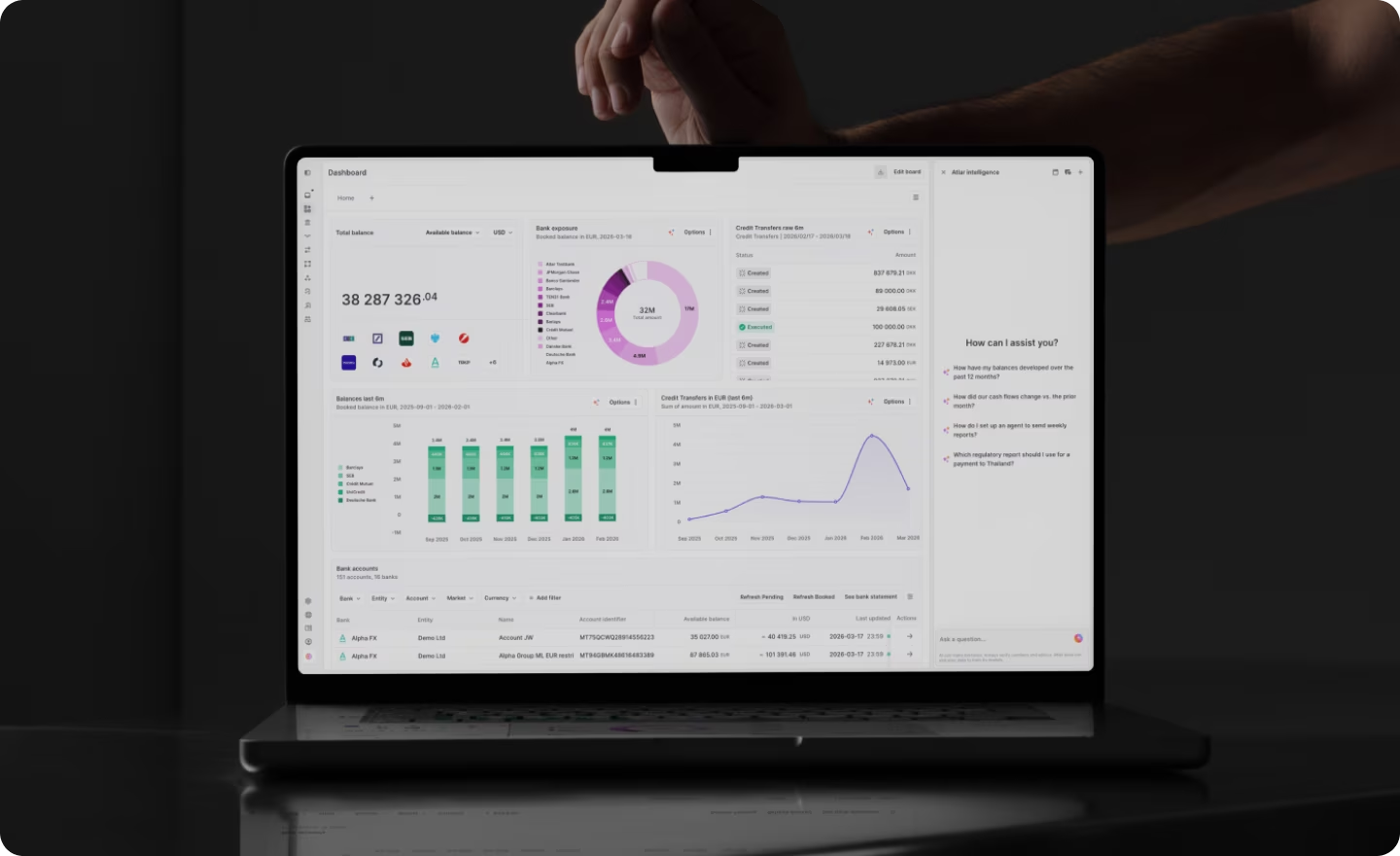
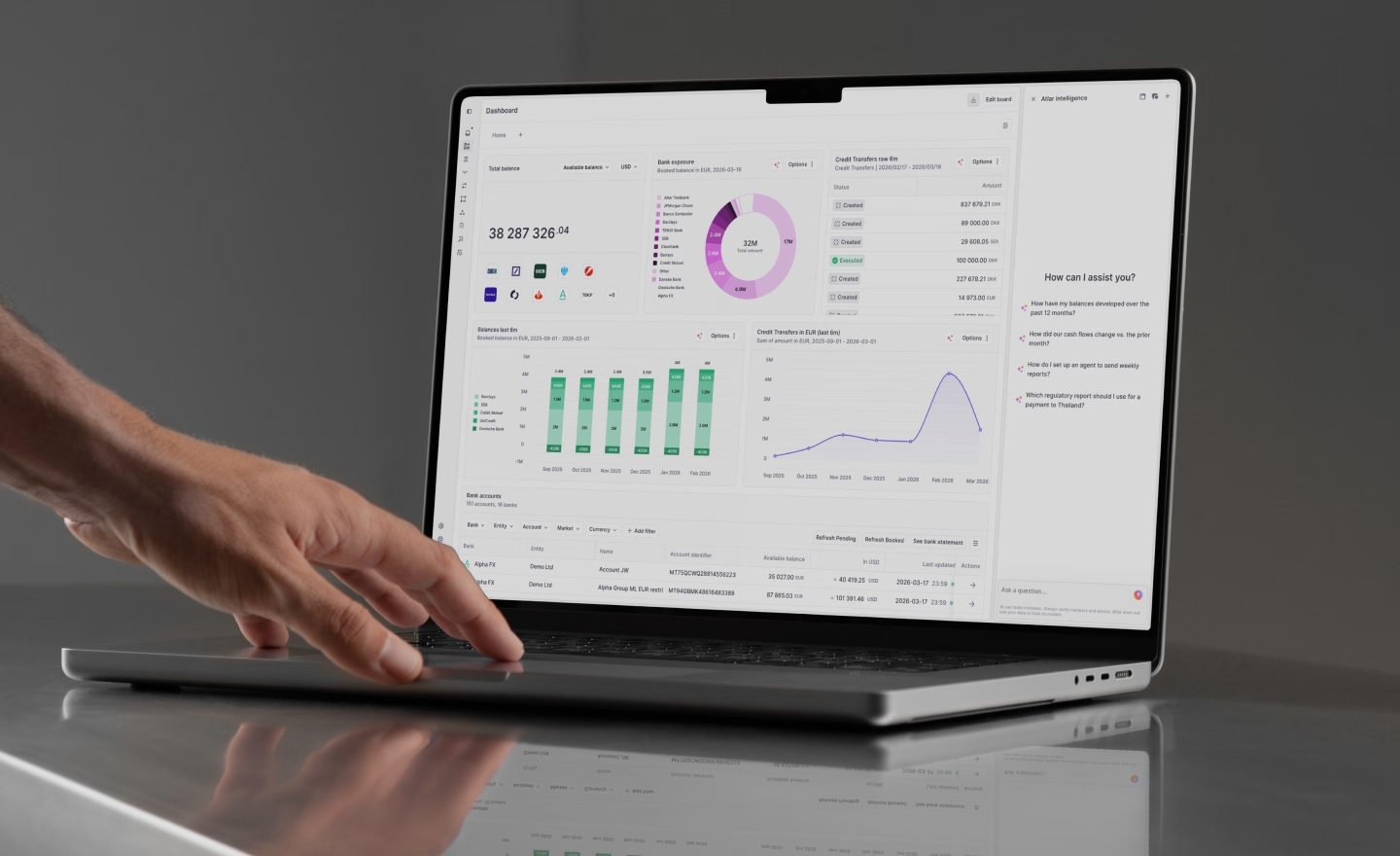
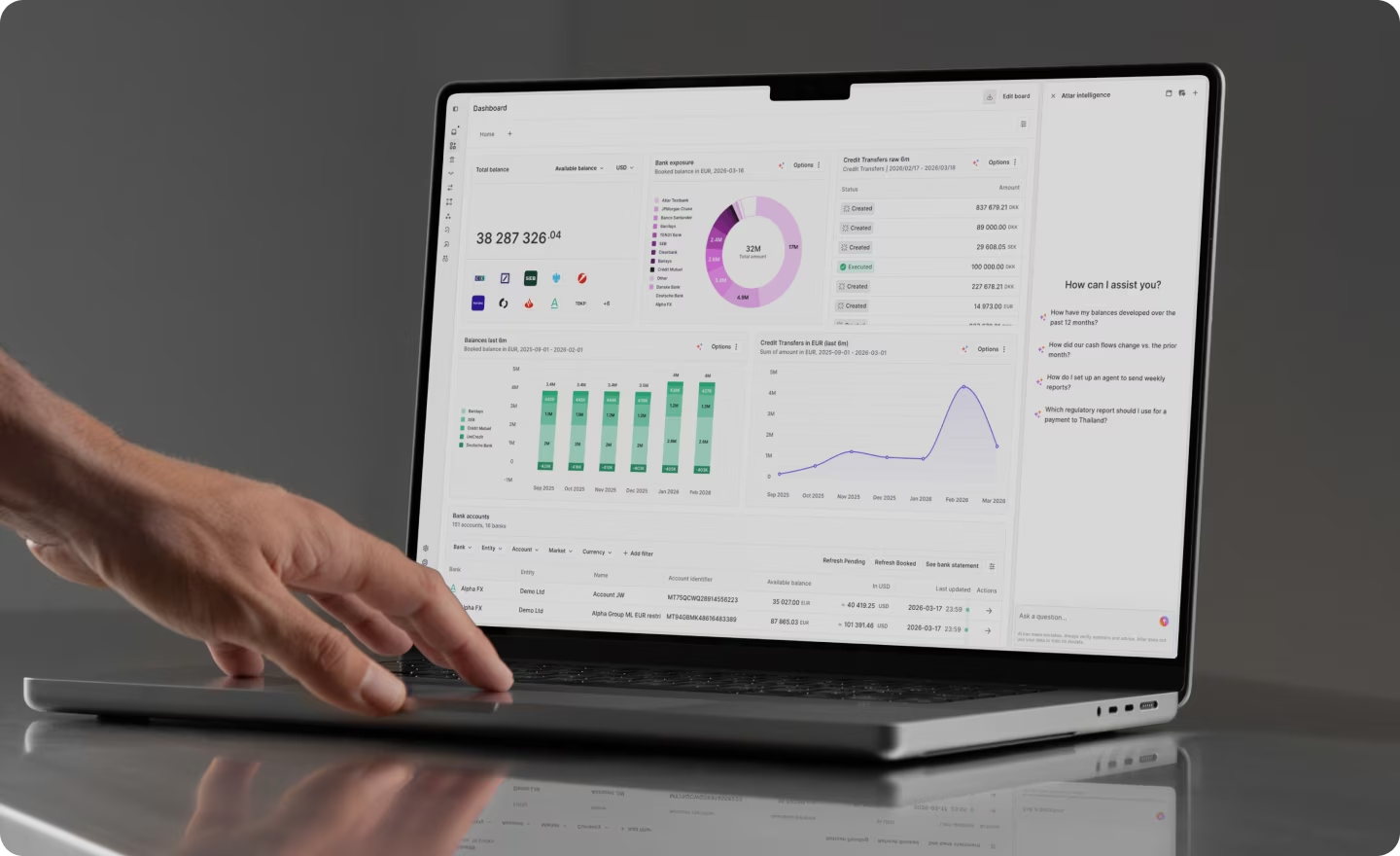
Atlar is an AI-native treasury platform covering cash management, payments, forecasting, bank reconciliation, investments, and debt management, with FX risk management to follow soon. It runs on direct bank connections in over 100 countries that Atlar builds and maintains itself, and most teams go live in under 90 days without external consultants. Atlar is rated 5 out of 5 on G2, has offices in Stockholm, London, and New York, and has been named NetSuite’s International Partner of the Year two years running.
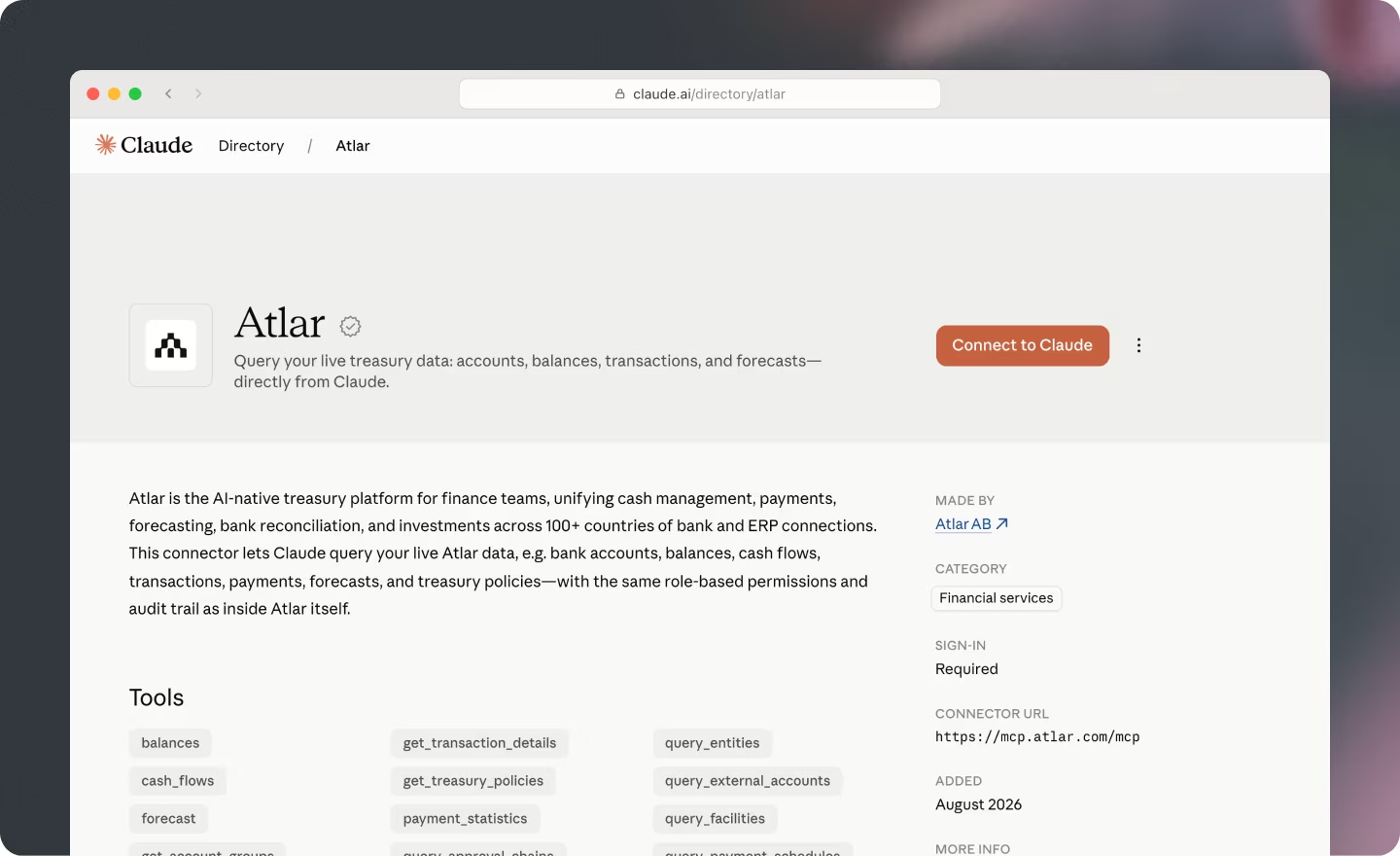
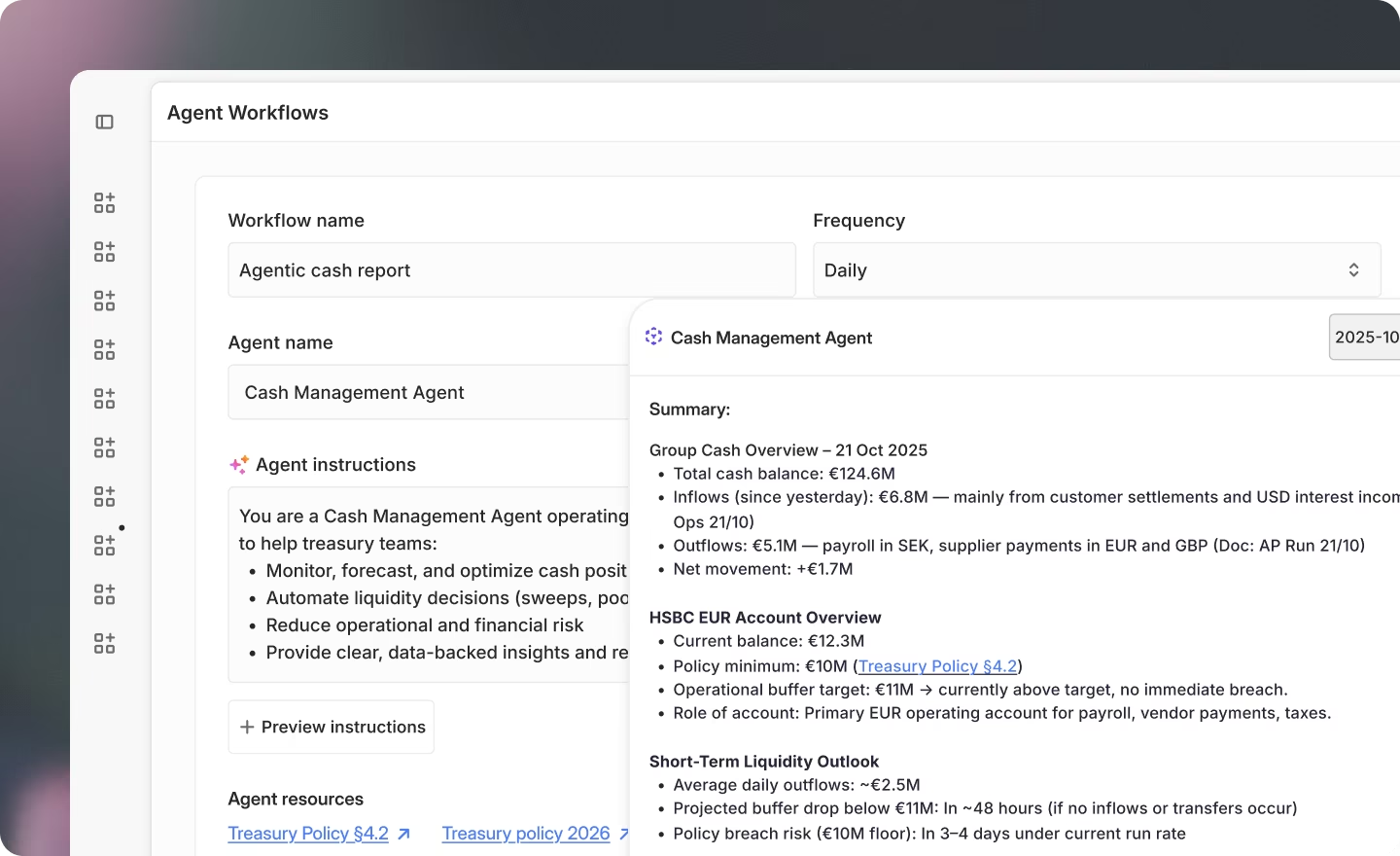
Because every balance and transaction comes straight from the bank, Atlar’s AI works on live data. Atlar Intelligence pairs an AI assistant for ad hoc questions with agents that run recurring work on a schedule, such as the daily cash position and monthly forecast updates. Each answer shows the agent’s reasoning and the accounts it used, and anything that moves money goes through the same approval chains as the team. Teams can also work with their treasury data in Claude, where Atlar is an official connector.
Nasdaq-listed Bandwidth connected its banking partners to Atlar so its treasury team can query live cash data in plain language, including through Claude. At Acne Studios, which runs more than 70 stores worldwide, the group cash position across nine banks on three continents now takes one click, down from 90 minutes a day in bank portals, and millions in subsidiary cash have moved into the group cash pool.
2. Kyriba
Founded in Paris in 2000 and now headquartered in San Diego, Kyriba is one of the largest cloud treasury providers, with more than 4,000 customers in 170 countries, including Adobe, HelloFresh, and Lockheed Martin. Private equity firm Bridgepoint became majority owner in 2019 in a deal reported at around $1.2 billion, and General Atlantic joined as a minority investor in late 2024. Its suite spans cash, payments, FX risk, and working capital, built on a network of around 10,000 bank connections. That breadth makes it a common pick for large multinationals, though it usually comes with longer implementations and a higher price point.
3. SAP Treasury and Risk Management
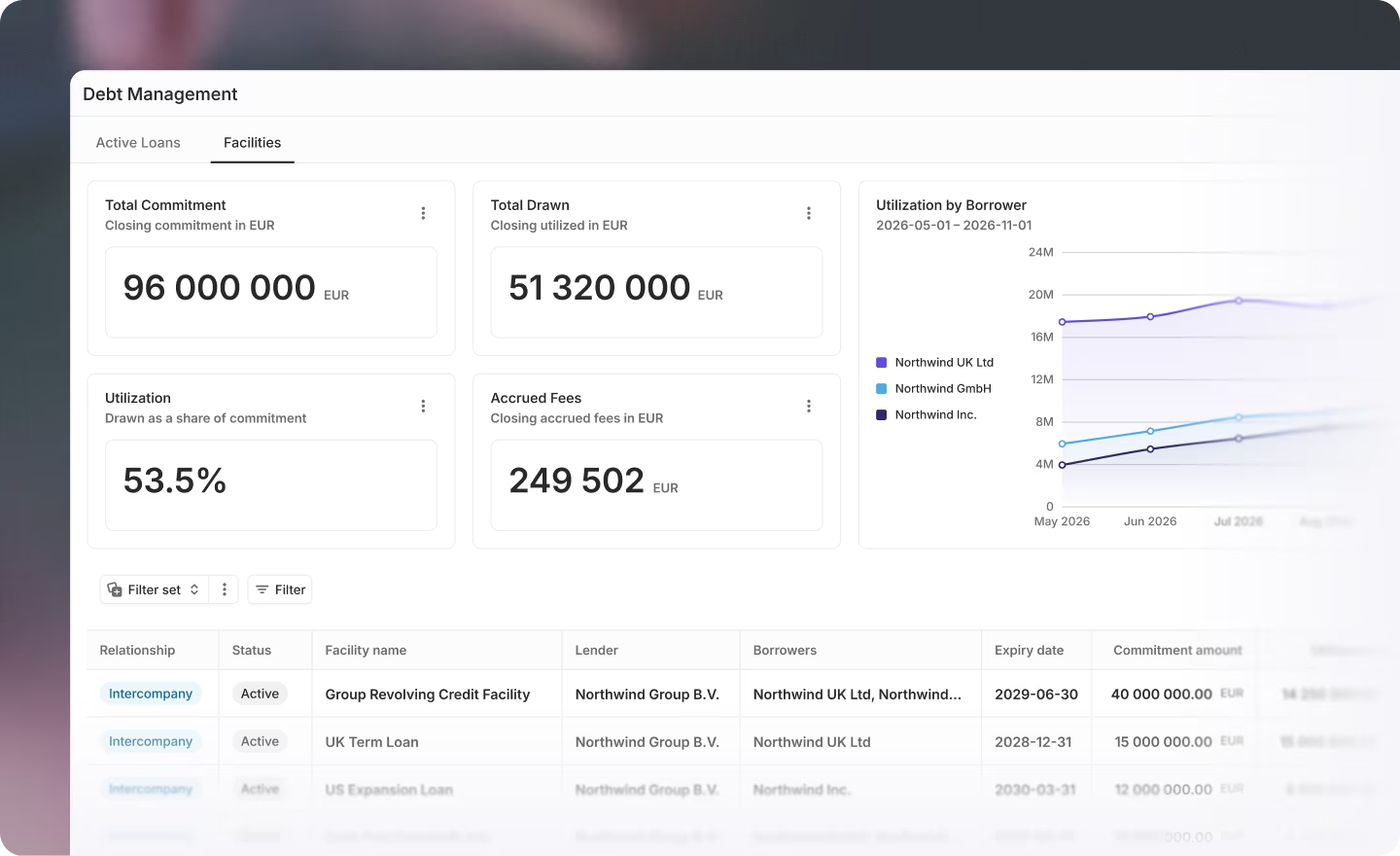
SAP Treasury and Risk Management is the treasury module of SAP S/4HANA, SAP’s flagship ERP. It covers FX, investment, and borrowing trades, automated capture of FX exposures, hedging proposals under IFRS and US GAAP, and debt and investment management, with bank communication running through SAP Multi-Bank Connectivity. Because treasury data lives natively in the ERP, it’s the natural pick for companies fully standardized on SAP. It’s typically rolled out as part of a wider S/4HANA program with a systems integrator, which makes it less flexible for companies running several ERPs.
4. ION Treasury
ION Group has built one of the broadest treasury portfolios through acquisitions, including Wallstreet Suite, IT2, City Financials, Treasura, and Reval, the cloud treasury platform it bought in 2016. Its products are known for depth in hedge accounting, derivatives, and financial risk. That makes ION a strong fit for large corporates with significant FX and interest rate exposure, where trading and risk sit at the heart of the treasury function. The flip side is that buyers need to choose between several overlapping product lines.
5. FIS Quantum
FIS Quantum, formally FIS Treasury and Risk Manager, Quantum Edition, is a long-standing treasury and risk system from one of the largest financial technology providers. FIS says its treasury suite serves over 1,000 organizations, and in 2025 it launched a Quantum Cloud Edition on the public cloud, with a new Liquidity Hub that pulls data from ERPs and bank APIs. It handles complex, highly customized requirements well, but implementation and upkeep typically call for dedicated IT and consulting support.
6. Ripple Treasury (formerly GTreasury)
GTreasury, a Chicago-based provider with more than four decades in treasury software, was acquired by Ripple for $1 billion in October 2025 and now operates as Ripple Treasury. It serves over 1,000 customers in 160 countries, covering cash visibility and forecasting, payments, risk, FX, debt, and investments. In April 2026 it added native digital asset accounts, letting finance teams hold and manage XRP and Ripple’s RLUSD stablecoin alongside fiat. It’s a fit for enterprises that want a modular setup, and for those exploring digital assets.
7. Nomentia
Nomentia is a Helsinki-based cash and treasury management provider with around 1,400 customers in more than 80 countries. London private equity firm Inflexion acquired a majority stake in 2023, in a deal reported at around €300 million. Its roots are in payment factories, cash pooling, and in-house banking, which makes it well suited to European companies centralizing payments across entities.
8. Trovata
Trovata built its business on corporate banking APIs, giving finance teams cash visibility, reporting, and forecasting across their bank accounts. It has raised around $80 million from backers including J.P. Morgan, Wells Fargo, Capital One Ventures, and Mastercard, adding State Street and PNC as investors in 2025. The same year it acquired ATOM, an enterprise TMS, to extend into debt, investments, intercompany transactions, and FX hedging. Its core strength remains cash reporting for US-centric teams, with the broader TMS functionality still new to the platform.
How to choose the best treasury management system for your business
There’s no single best TMS for every company. The right choice depends on how many banks and entities you run, how much IT support you have, and what you need treasury to do over the next few years. These are the questions worth answering before you book demos.
Start with connectivity
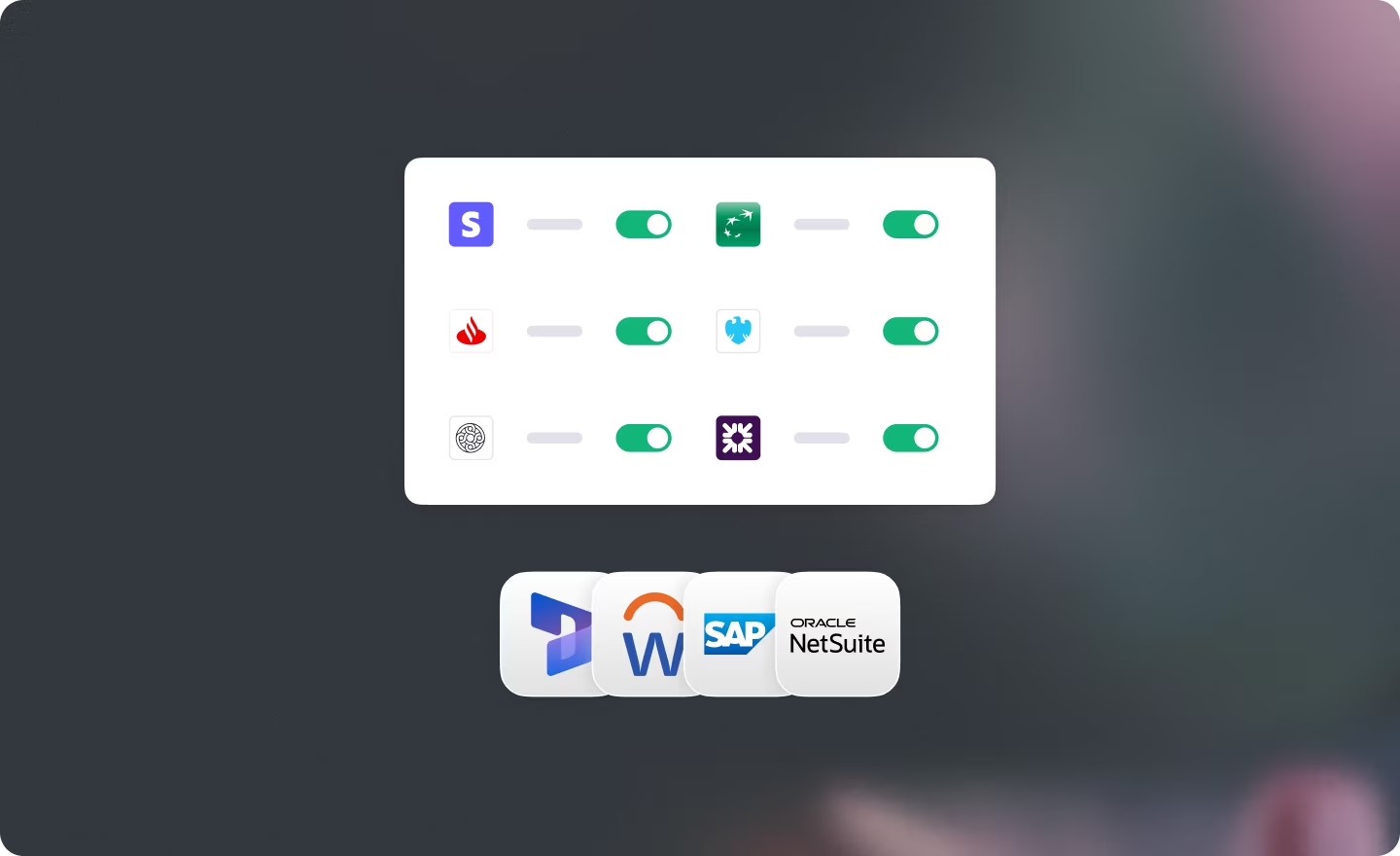
List every bank, entity, and ERP the system needs to connect to. Ask each vendor whether connections are API-based or file-based, and who builds and maintains them. Legacy platforms often rely on batch files that arrive every 24 to 48 hours, so your cash position is out of date before you see it.
Match functional depth to your team
Every TMS covers cash visibility, payments, and forecasting. Hedge accounting, in-house banking, and advanced risk modules matter mainly for large treasury departments. More functionality isn’t always better, because extra complexity slows adoption.
Be realistic about IT capacity
On-premise and hosted systems offer the most room for customization, but need IT resources to run and upgrade. Cloud platforms are faster to deploy and update automatically, so the finance team can own the system day to day.
Look at total cost, beyond the license
Implementation, professional services, and bank connections add up quickly. For complex, multi-entity setups, annual costs can exceed $100,000, and professional services often add another 20 to 25 percent of contract value.
Ask how quickly you’ll see value
Traditional implementations take 4 to 18 months, while modern platforms typically go live in two to three. The sooner you have live cash data, the sooner you can act on it, whether that means putting idle cash to work or tightening payment controls.
Test the AI on your own data
Most vendors now claim AI. Ask whether it runs on live bank data or a nightly copy, whether it can act or only answer questions, and whether every output traces back to the transactions behind it. It’s also worth asking how it works with the AI tools your team already uses, such as Claude.
Consider where you are today
If you’re buying your first TMS, prioritize ease of implementation and usability. If you’re replacing an older system, check that it covers your core needs, then focus on real-time connectivity and how well it will adapt as the business grows.
What “modern” treasury really means
Plenty of vendors now describe themselves as cloud-based or AI-powered. The real difference is in how the platform connects to your banks. Legacy systems were built around batch files that arrive once a day, so the data is already out of date by the time anyone looks at it. Modern platforms connect to banks through APIs and managed connections, so balances and transactions update throughout the day.
Language models are probabilistic, while treasury work has to be exact and traceable, so an agent is only as reliable as the data it reads and the tools it can act through. A modern platform should let you trace any AI answer back to the bank statement behind it, and keep people approving anything that moves money.
Where Atlar fits in
Atlar was built API-first from day one. It connects to banks in over 100 countries and to ERPs including NetSuite, SAP S/4HANA, Microsoft Dynamics 365, and Workday, as well as AI-native ERPs such as Campfire, Light, and Rillet. Cash, payments, forecasting, reconciliation, investments, and debt all run from the same live bank and ledger data, so there are no files to move between systems.
We rank Atlar first for most growing mid-market and enterprise finance teams, especially those that have outgrown bank portals but don’t want a year-long implementation. Companies with heavy derivatives or hedge accounting needs may still be better served by ION or SAP.
Getting started with Atlar
Most teams go live on Atlar in under 90 days, with Atlar’s team building and maintaining the bank connections. If you’d like to try it first, sign up for a demo account at app.atlar.com, which you can also connect to Claude. To see how Atlar would work for your team, book a demo or contact us.