Key takeaways
- Mid-market finance teams face enterprise-level complexity, with multiple banks, entities, and currencies, but usually without a dedicated treasury department or IT support.
- Time to value, ease of use, and managed bank connectivity therefore matter more than breadth of features.
- Atlar is the best fit for most mid-market companies, with most teams live in under 90 days and no external consultants needed.
- Enterprise suites like SAP, ION, and FIS are rarely the right fit at this stage, because of their cost, implementation time, and reliance on IT.
- Lighter cash visibility tools can work for simple setups, but many mid-market teams outgrow them once payments, controls, and forecasting become priorities.
This guide compares the leading treasury management systems for CFOs and finance leaders at mid-market companies choosing their first, or next, treasury platform. Atlar wrote it, and we’ve assessed every vendor, including ourselves, on the same criteria.
The shortlist at a glance
| Vendor | Best for | Typical company size | Standout strength |
|---|---|---|---|
| Atlar | Most mid-market finance teams | Mid-market to enterprise | Managed, real-time bank connectivity with fast go-live |
| Kyriba | Mid-market companies scaling into global enterprises | Upper mid-market to large enterprise | Breadth of functionality |
| Nomentia | European companies centralizing payments | Mid-market to large, Europe | Payment factory and cash pooling |
| Embat | Companies in Spain, the UK, and Ireland | Mid-market, Europe | AI analyst for forecasting and hedging |
| Trovata | US teams that mainly need cash reporting | Mid-market, US | Quick cash dashboards |
| Agicap | Companies focused on cash flow forecasting | SMB to mid-market | Forecasting and cash flow planning |
| Nilus | Teams exploring AI-led cash operations | Mid-market | AI-driven cash reporting |
What is a treasury management system?
A treasury management system (TMS) connects a company’s banks, entities, and ERP, so the finance team can see its cash and act on it in one place. That means live balances, payments under consistent approval controls, reconciliation, and forecasting from the same data. For a wider look at the category, including the enterprise suites, see our guide to the best treasury management systems in 2026.
Why mid-market treasury is different
Mid-market companies are typically defined as businesses with annual revenue between $10 million and $1 billion. They’ve outgrown their startup setup and often run accounts across several banks, entities, and currencies, sometimes in a dozen countries, with the same payment risks and cash questions as a large multinational. But they usually do it with a lean finance team, no dedicated treasurer, and little or no IT support for finance systems.
For years, the choice was between spreadsheets and bank portals on one side, and enterprise treasury suites built for Fortune 500 companies on the other. The first doesn’t scale. The second takes months to implement, relies on consultants, and costs more than most mid-market budgets allow.
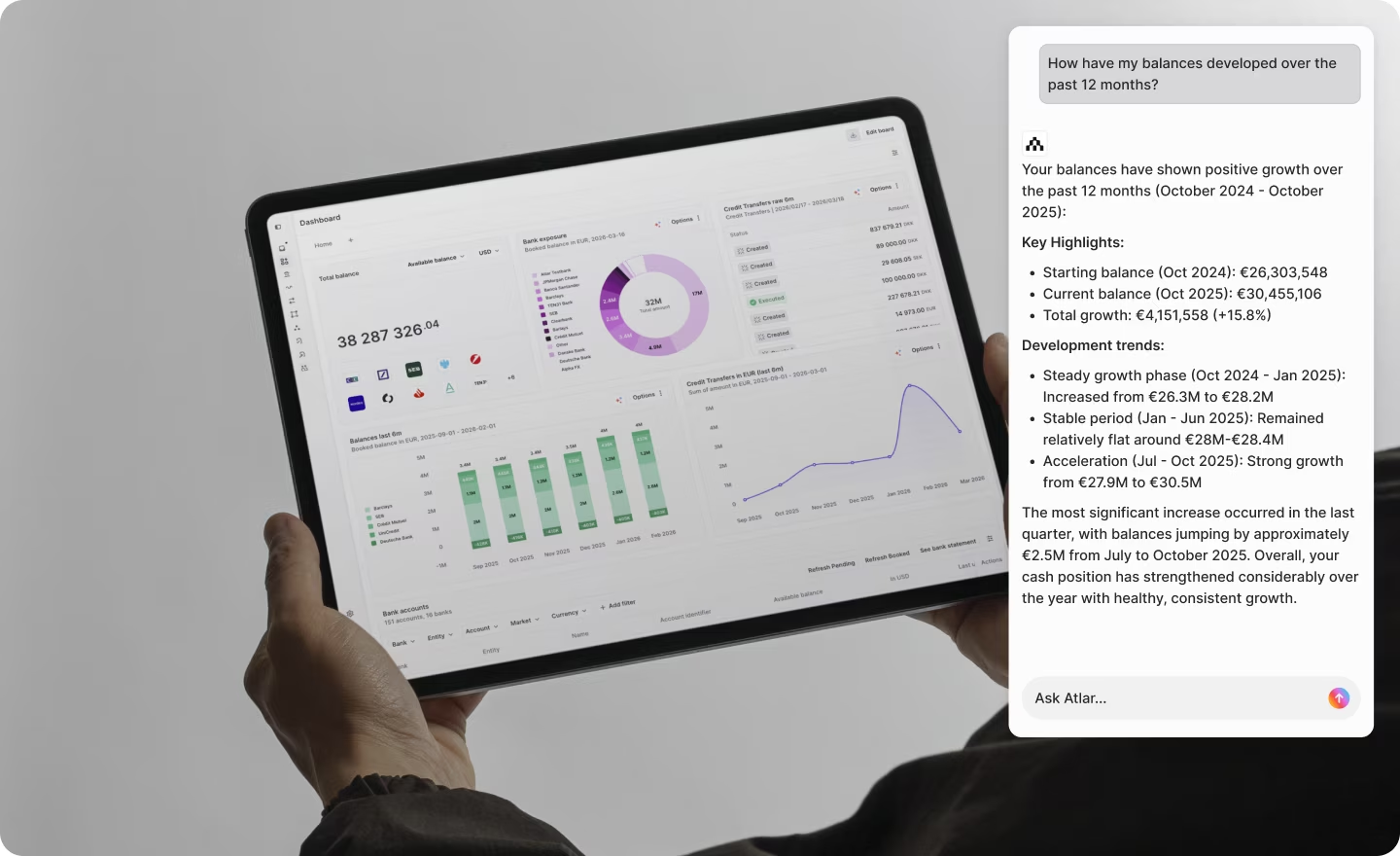
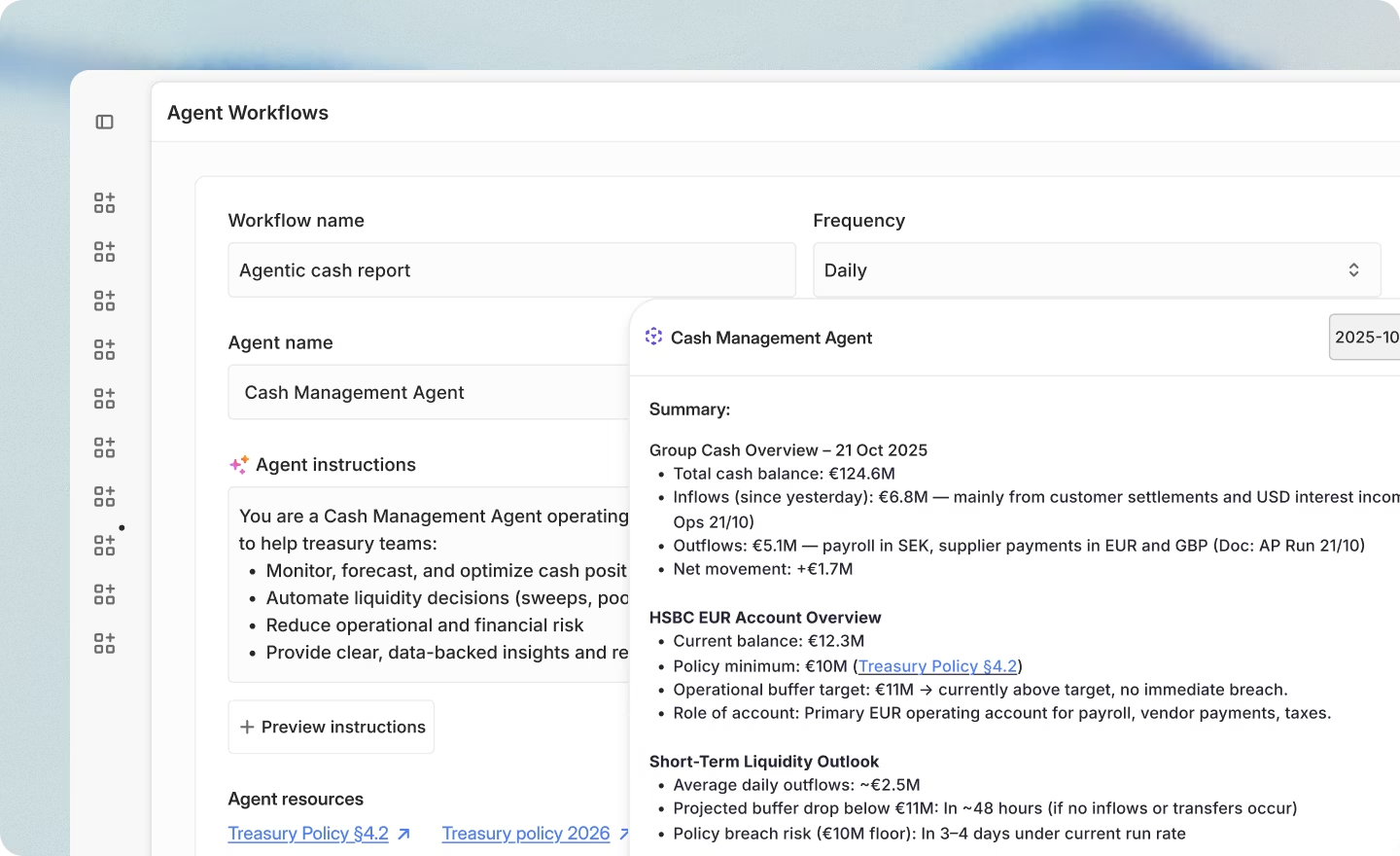
AI changes the math for a lean team. A finance team of three or four can’t hire its way through every new bank and entity, but agents can take on the daily cash position, transaction matching, and forecast updates, leaving people to review and decide. Agents can only do that work with live data from every bank, and many lighter tools can’t provide it.
A new generation of platforms is built for the space in between. For a mid-market team, the questions that matter most are practical ones: how quickly can we go live, who maintains the bank connections, can the finance team run it without IT, and will it still fit when we double in size? We assessed each vendor on those questions, alongside cash visibility, payments and controls, forecasting, ERP integration, and total cost of ownership.
The best treasury management systems for mid-market companies
1. Atlar
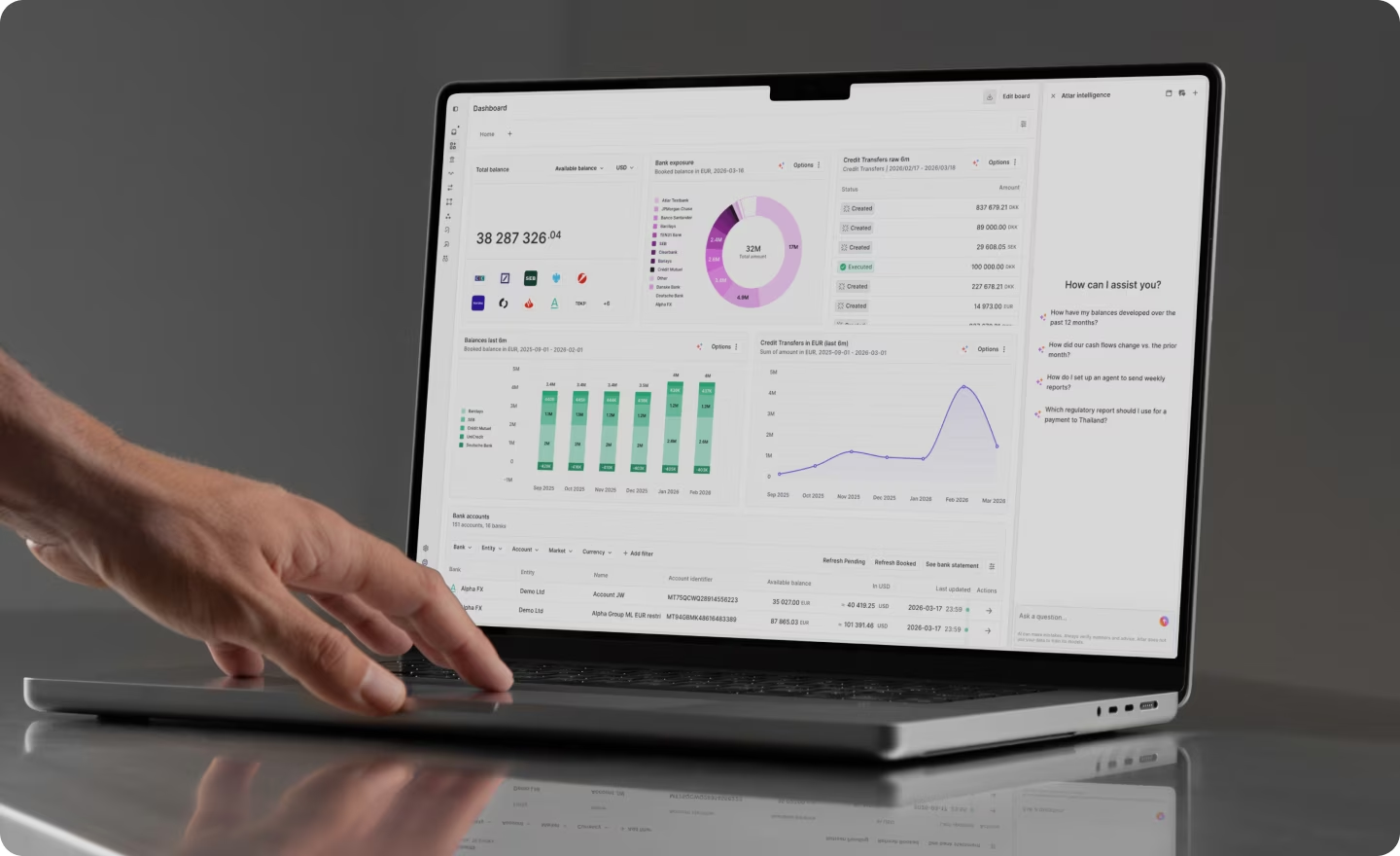
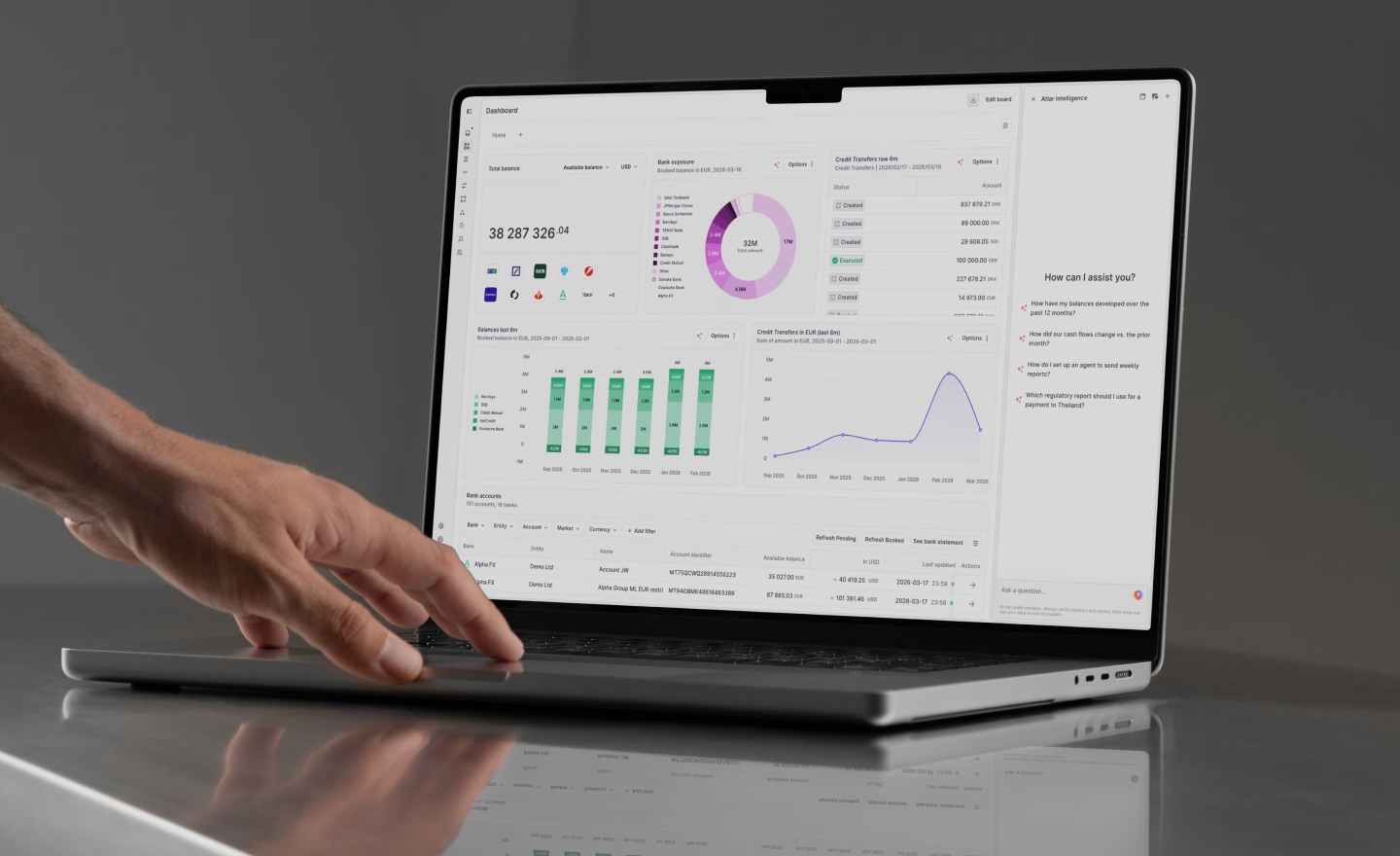
Atlar is an AI-native treasury platform built for this stage, covering cash management, payments, forecasting, bank reconciliation, investments, and debt management, with FX risk management to follow soon. Atlar builds and maintains direct bank connections in over 100 countries, and most teams go live in under 90 days, with no file uploads, bank logins, or external consultants. It’s rated 5 out of 5 on G2.
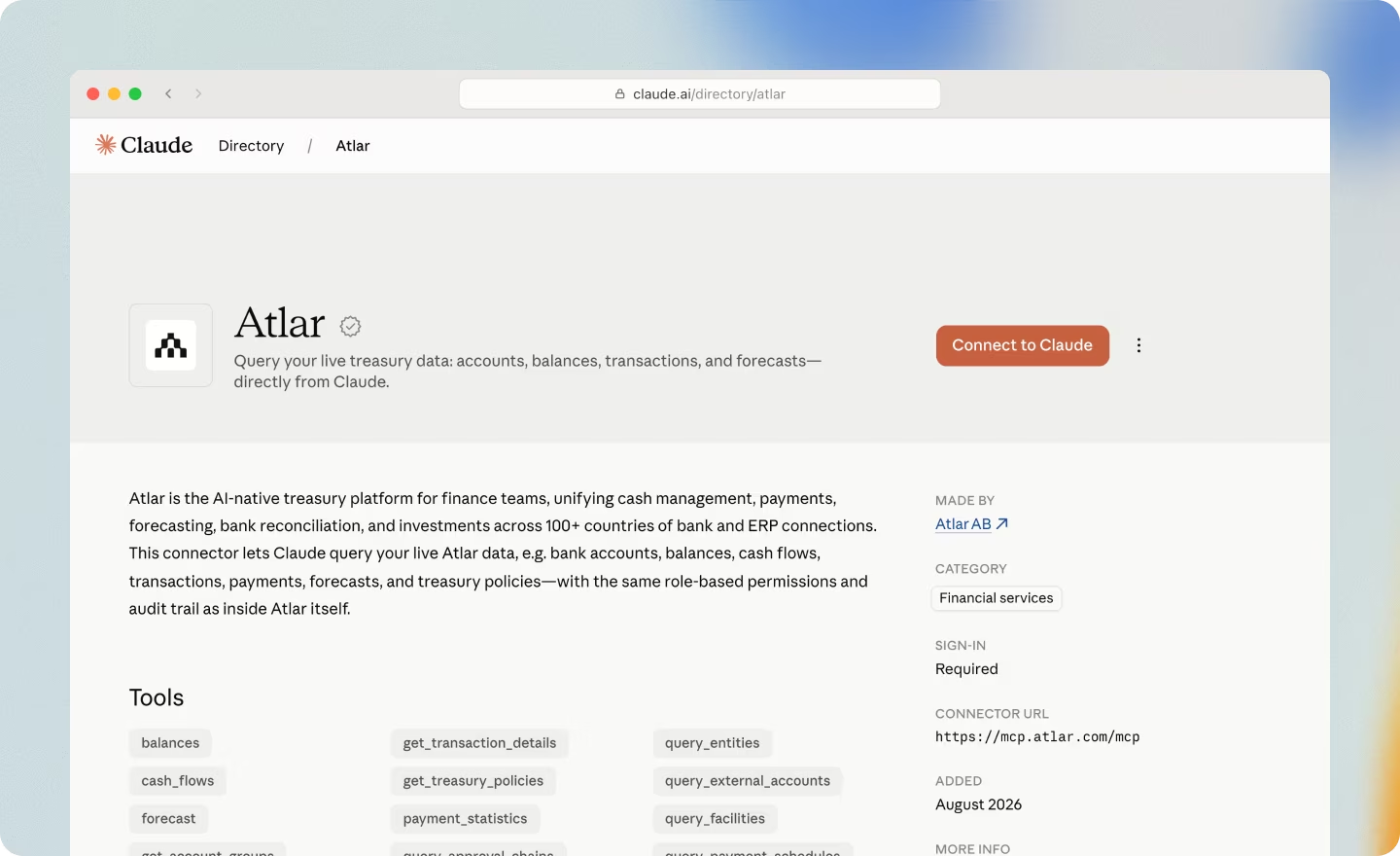
For a lean team, the AI is where the time comes back. Atlar’s agents run recurring work such as the daily cash position and monthly forecast updates, show the data behind every answer, and leave anything that moves money for people to approve. Finance teams can also build their own tools on the same data. Storytel’s treasury manager uses Atlar’s Claude connector to produce the monthly treasury report and run a cash monitoring agent. AI-first companies such as Lovable and Parloa chose Atlar partly for its AI features, and partly because the platform is built to keep pace as AI develops.
Flex, the AI-native private bank for business owners, brought nine banks onto Atlar in under six weeks. Its agents now deliver the daily cash position before 8am and sweep more than $50 million in idle cash into interest-bearing funds every night, adding up to a 5x ROI in the first year. “This is one of the easiest implementations we’ve been through,” says Brian Ehrlich, Head of Finance and Operations at Flex.
At Forto, the Berlin-based digital freight forwarder, a corporate finance team of four runs treasury across offices in Europe and Asia, and checking the group’s daily liquidity takes about 15 minutes. “If Atlar was not part of our processes, I would have to hire double the team,” says Caio Kruse, Team Lead for Corporate Finance.
2. Kyriba
Kyriba is one of the largest cloud treasury providers, with more than 4,000 customers in 170 countries and a suite spanning cash, payments, FX risk, and working capital. Founded in Paris in 2000 and now headquartered in San Diego, it has been majority-owned by private equity firm Bridgepoint since 2019. For upper mid-market companies that expect to become complex global groups, buying that breadth early can make sense. The trade-off is that independent reviews point to implementations of three to eight months and enterprise-level pricing, and describe Kyriba as primarily used by large, global corporations.
3. Nomentia
Nomentia is a Helsinki-based cash and treasury management provider with around 1,400 customers in more than 80 countries. London private equity firm Inflexion acquired a majority stake in 2023, in a deal reported at around €300 million. Its roots are in payment factories, cash pooling, and in-house banking, which suits mid-market and larger European companies centralizing payments across entities. Its focus is firmly European, with all of its offices in Europe.
4. Embat
Embat is a Spanish treasury platform founded in 2021 by Antonio Berga and Carlos Serrano. It raised a €30 million Series B in May 2026, led by Cathay Innovation with Creandum among existing investors, bringing total funding to €50 million, and serves more than 400 European corporate clients. Its platform covers payments, accounting, and reconciliation, with an AI analyst called TellMe for forecasting and hedging. Its base is in Spain, and it’s now using the new funding to grow in the UK and Ireland, where it launched around a year ago.
5. Trovata
Trovata built its business on corporate banking APIs, giving finance teams cash visibility, reporting, and forecasting across their bank accounts. It has raised around $80 million from backers including J.P. Morgan, Wells Fargo, Capital One Ventures, and Mastercard, adding State Street and PNC as investors in 2025, when it also acquired the enterprise TMS ATOM. It’s quick to set up for teams that mainly need cash dashboards. Its roots are in cash visibility rather than payments or hedging, and independent reviewers suggest validating payment approvals and hedging depth during evaluation.
6. Agicap
Agicap is a Lyon-based cash management platform with around 8,000 customers, roughly half of them in France and most of the rest elsewhere in Europe. It raised a €45 million Series C from AVP in 2024, following a $100 million round in 2021. Its CEO describes its focus as mid-sized companies with average annual revenue of €5 to €10 million, and the product centers on cash visibility and forecasting, with accounts payable and receivable added more recently. That makes it a good fit at the smaller end of the mid-market, where forecasting and cash planning matter more than payment controls.
7. Nilus
Nilus describes itself as a proactive, AI-powered treasury management platform, focused on real-time cash visibility, AI-driven forecasting, and automated reconciliation. Founded by Daniel Kalish, formerly of PayPal, and Danielle Shaul, formerly of Fundbox, it raised $10 million in 2025 led by Felicis and Vesey Ventures, bringing total funding to $18.6 million. Named customers include Alloy, Taboola, and Made In Cookware. With less funding than most vendors on this list, it’s earlier in its journey than more established platforms.
Why enterprise suites often don’t fit
SAP Treasury and Risk Management, ION Treasury, and FIS Quantum are strong products, and they appear on almost every enterprise shortlist. For most mid-market companies, though, they solve the wrong problem. They were built for the largest enterprises, with big treasury departments managing hedging portfolios and complex risk, and for a lean mid-market team the costs usually outweigh the extra functionality, for four reasons.
Long, expensive implementations
Traditional TMS projects take between 4 and 18 months on average, according to a 2019 Deloitte report cited in Atlar’s tooling guide. Systems are configured by dedicated specialists and consultants, and ongoing running costs are hard to reduce without replacing the system entirely.
Built for configurability over usability
Enterprise suites are designed to be configured to almost any requirement, which makes them powerful but often unintuitive. Teams spend more time on training, and changing a report or a process can mean another consulting project. Many are still upgraded on fixed annual cycles rather than continuously.
Batch connectivity
Most legacy systems rely on batch files from the banks, with delays of up to 48 hours, so the cash position is out of date by the time anyone looks at it. Many also struggle to connect to modern, API-based finance tools such as payment providers and new ERPs.
Hard to leave
Once a company has invested a year and a significant budget in an implementation, switching is costly, and the lock-in tends to weaken a customer’s negotiating position over time.
Why TMS-lite tools often fall short
At the other end of the market sit lightweight cash visibility tools, sometimes called TMS-lite. They’re quick to adopt and work well for basic cash management and reporting, and they can be enough for a company with two banks and simple needs. But many mid-market teams outgrow them within a year or two, once payment controls, approvals, and forecasting matter as much as seeing the balance, and switching then means a second migration.
Indirect bank connectivity
Many TMS-lite tools don’t connect directly to banks. Instead, they rely on third-party aggregators or open banking APIs, which can mean gaps in coverage for corporate accounts, certain countries, or certain currencies, and connections that need to be re-authorized periodically.
Read-only by design
Some of these tools only show data. They’re good for seeing balances and building reports, but they often can’t initiate payments, so payment runs and approvals still happen in separate bank portals.
Thin on the rest of treasury
Forecasting is often basic, and support for debt, investments, and putting idle cash to work is usually limited or missing.
Where Atlar fits in
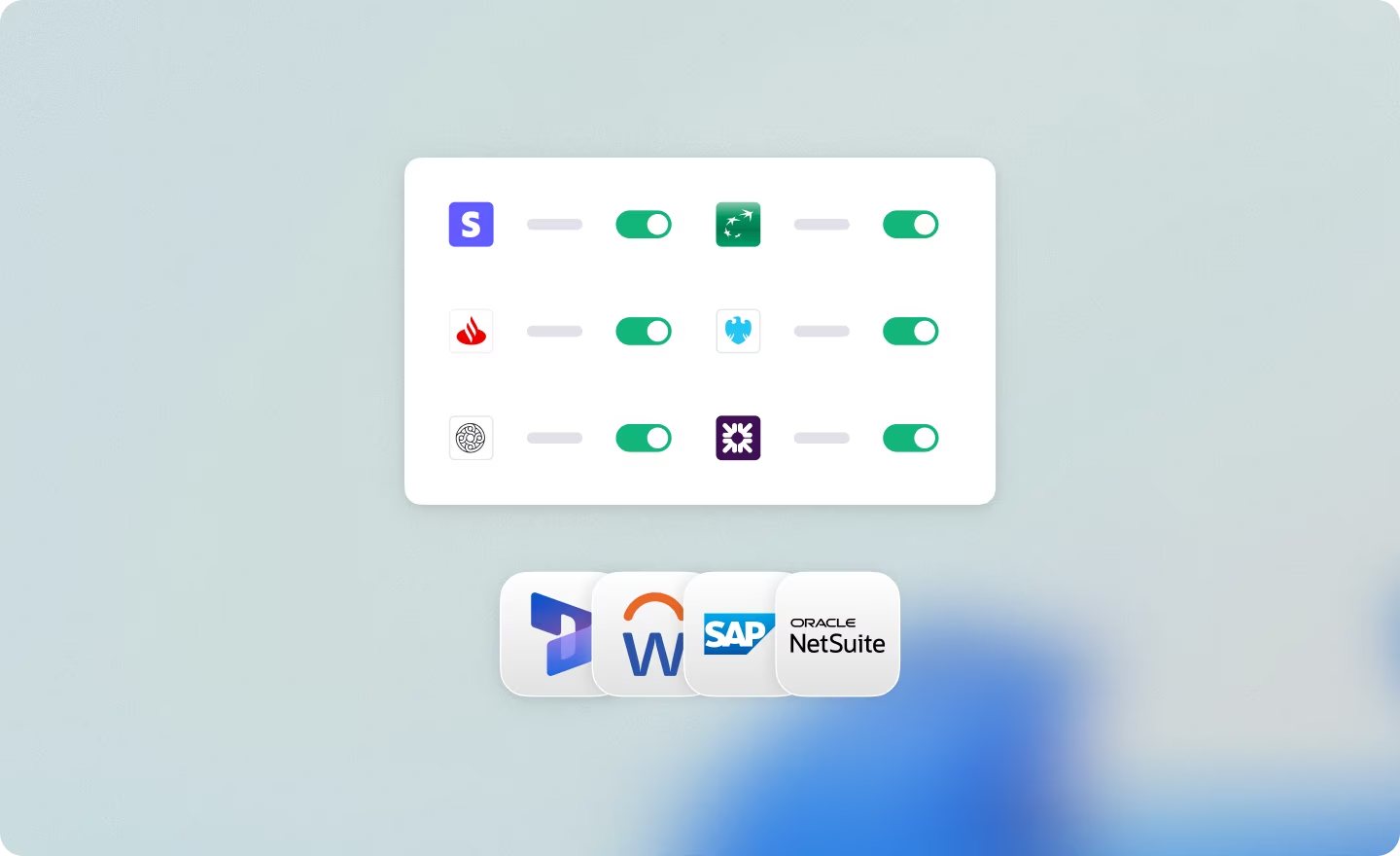
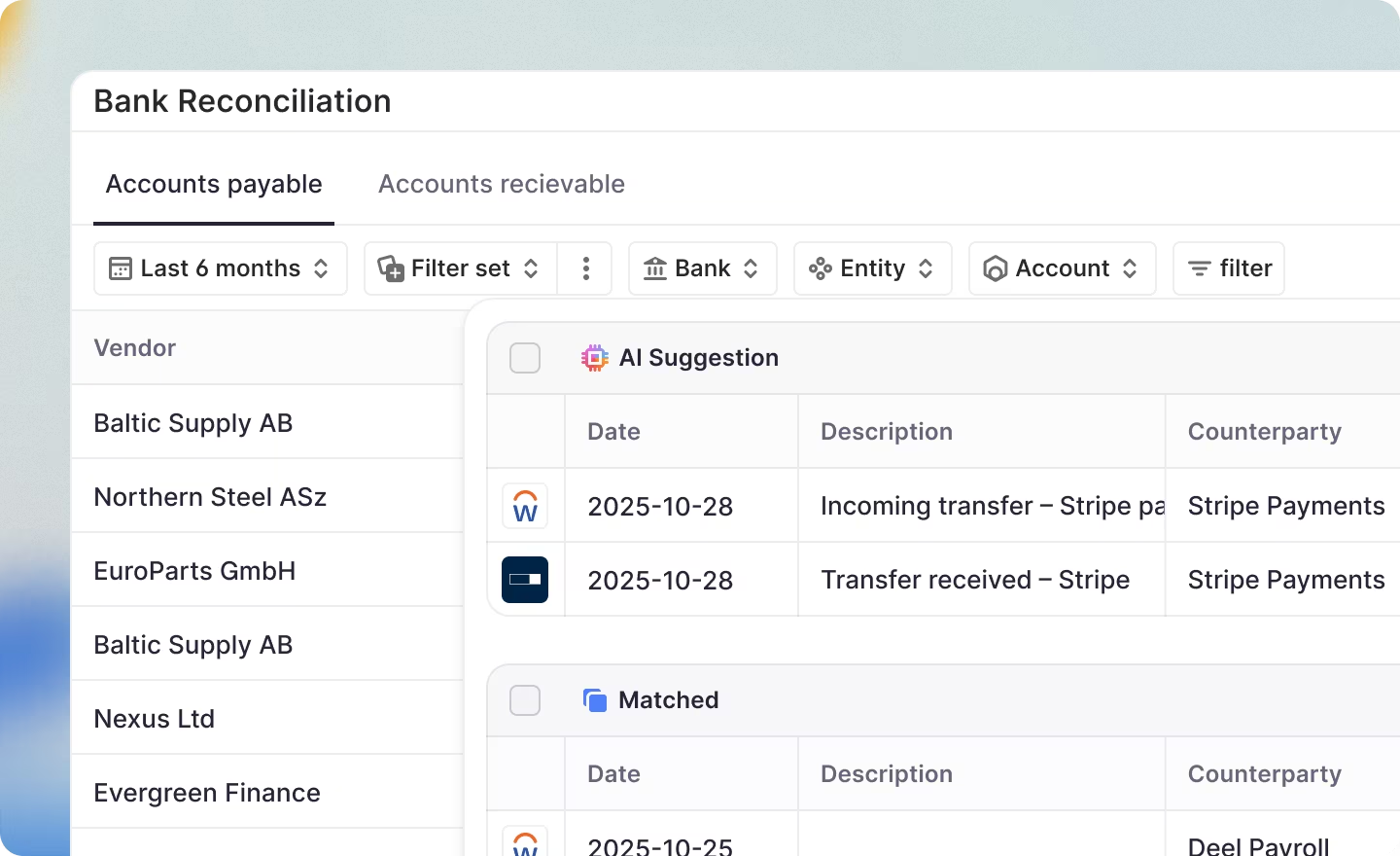
Atlar sits between enterprise suites and TMS-lite tools. It gives mid-market teams the depth they’ll need as they grow, including payments with approval chains, AI-powered bank reconciliation, forecasting, investments, and debt management, without the implementation burden of an enterprise suite. Bank connections across over 100 countries are built and maintained by Atlar, and integrations with ERPs such as NetSuite, Microsoft Dynamics 365, SAP S/4HANA, and Workday keep cash and ledger data in sync.
We rank Atlar first for most mid-market companies. Teams with very simple needs may start with a lighter tool, and those with heavy FX hedging requirements may still look at enterprise risk systems, but for a finance team that wants control and visibility this quarter, not next year, Atlar is the strongest option.
Getting started with Atlar
Most mid-market teams go live on Atlar in under 90 days, without IT support or consultants, and Atlar keeps maintaining the bank connections after launch. To see how it would work for your team, book a demo or contact us.