MT940 files
MT940 files are standardized electronic bank statement formats used by banks to share daily balance and transaction information with businesses.
Introduction to MT940
MT940 is part of the SWIFT MT (Message Type) series of financial message formats and is widely used around the world for electronic bank reporting. It provides a structured way for banks to communicate end-of-day account information—such as opening and closing balances, credits, debits, and transaction details—to their corporate clients.
The format is particularly common in Europe and among multinational organizations that manage accounts across multiple banks and jurisdictions. By providing a consistent structure, MT940 files allow companies to import account data directly into their ERP or treasury management systems (TMS) for reconciliation, reporting, and cash forecasting.
How MT940 files work
An MT940 file contains information about a single bank account for a given day. Each file follows a structured text-based format defined by SWIFT, consisting of specific fields identified by numbered tags. Common examples include:
- :20: Transaction reference number
- :25: Account identification
- :60F: Opening balance
- :61: Transaction details (for each entry)
- :62F: Closing balance
Each field conveys standardized data about the account or its transactions, enabling systems to parse and process the file automatically. MT940 files are typically delivered daily via SWIFT, SFTP, or host-to-host connections.
MT940 in bank reporting
Banks send MT940 files to their corporate clients to provide a daily summary of all postings to an account. This allows finance and treasury teams to see which payments have cleared, which funds are still pending, and what the final end-of-day balance is.
Treasury systems import these files to update cash positions and reconcile them against internal ledgers. Because the format is standardized, companies can receive consistent data from multiple banks, reducing manual work and supporting straight-through processing (STP) for reconciliation and reporting.
MT940 vs. BAI2 and ISO 20022 formats
While MT940, BAI2, and ISO 20022 (CAMT.053) files serve similar purposes—providing account balance and transaction data—they differ in structure and regional usage.
- MT940: A SWIFT standard, common in Europe and international banking. Uses a text-based, tagged format.
- BAI2: Originated in the US. Uses a simpler, comma-separated format for domestic reporting.
- ISO 20022 (CAMT.053): A newer, XML-based format providing richer, structured data.
Compared to ISO 20022, MT940 contains less detailed transaction metadata but remains widely supported and compatible with most corporate banking systems. Many companies continue to rely on MT940 files for global reporting due to their stability and broad bank coverage.
Benefits of MT940 files
MT940 files offer several operational advantages for corporate treasury teams:
- Standardization: A consistent, internationally recognized format for bank statements.
- Automation: Enables automatic import and reconciliation within ERP and TMS platforms.
- Multi-bank compatibility: Supported by nearly all international banks.
- Visibility: Provides a clear, daily view of account balances and cash movements.
- Reliability: A long-established standard with predictable formatting and delivery.
These benefits make MT940 an essential component of many companies’ global cash management and reconciliation processes.
MT940 in treasury operations
Treasury teams rely on MT940 files to maintain accurate and up-to-date views of liquidity. By consolidating daily statement data from all banking partners, they can monitor cash positions across accounts, entities, and currencies.
Automated workflows import MT940 files into treasury systems, where they are reconciled with internal transactions and used to update cash forecasts. This automation reduces manual effort and ensures that finance teams base their liquidity decisions on verified, bank-confirmed data.
How Atlar can help with MT940 reporting
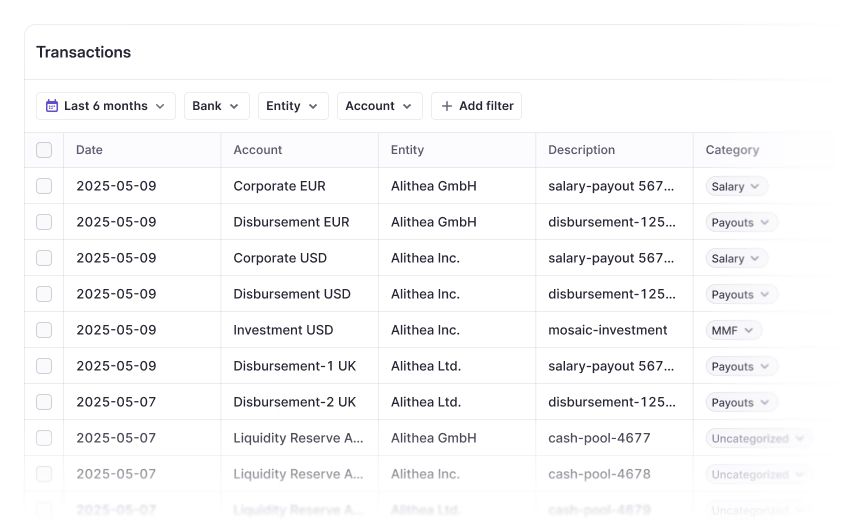
Atlar connects directly to banks to automatically collect bank statement data in standard reporting formats such as MT940, BAI2, and ISO 20022. This data is ingested and standardized within the platform, giving finance teams a unified view of balances and transactions across accounts, entities, and markets.
By automating bank data collection and centralizing it in a single platform, Atlar removes the need for manual file downloads and processing. Finance teams gain up-to-date visibility over liquidity across all connected accounts, enabling more efficient cash management and reporting. Book a demo to learn more.
You can unsubscribe anytime.
Further reading
See Atlar in action.
Enter your work email to watch a live product demo.