What are AI agents in treasury?
AI agents in treasury are software systems that take on specific treasury tasks, such as building a cash position or reviewing outgoing payments, working from a company's own financial data and acting under human oversight.
Introduction to AI agents in treasury
An AI agent is a system that pursues a goal on its own, working out and carrying out the steps rather than waiting to be told each one. Applied to treasury, that means a system pointed at a defined job, building the daily cash position, checking a payment run, watching balances against limits, and left to assemble the answer from live data, surfacing it for a person to act on.
Unlike a scheduled report or a fixed integration, which runs the same path every time, an agent is given the goal and the data it can reach and works out how to get there. That suits treasury work, where the inputs change daily but the question stays the same. It functions something like a junior analyst who prepares the same briefing each morning, except it does not tire and it runs whenever you need it.
What an agent does not do is decide on its own to move money or change a record. It prepares and proposes, and a person approves. That boundary is what makes the approach usable in a function where a wrong action is expensive, and it is covered in more depth under human-in-the-loop AI.
Why treasury suits AI agents
Treasury is a strong fit for agents because much of its work shares the same shape. The job is well-defined and recurring, but the inputs change constantly. A daily cash position has a clear goal and a path that shifts with every booked transaction. A payment review asks the same questions each day of a different set of payments. Work like this is too variable to capture in a fixed script but too routine to need a person assembling it by hand, which is the gap an agent fills.
The harder part is rarely the reasoning. It is the data. Treasury data is spread across bank portals, payment systems, and one or more ERPs, often a day or more out of date by the time it is gathered. An agent reasoning over stale or partial figures produces unreliable output, however capable the model behind it. This is why useful treasury agents depend on bank connectivity and ERP integration that bring the data together and keep it current, before any agent reasons over it.
What AI agents do in treasury
Agents are applied across the operational side of treasury. Common examples include:
- Cash positioning: pulling balances from every connected account and presenting the current position by entity and currency, with the day compared against recent trends.
- Payment review: checking a day's outgoing payments for failures, items stuck in approval, unusually large or irregular amounts, and upcoming outflows that affect liquidity.
- Cash forecasting: drawing on historical transactions and known commitments to project the cash flow forecast forward, and updating it as new data arrives.
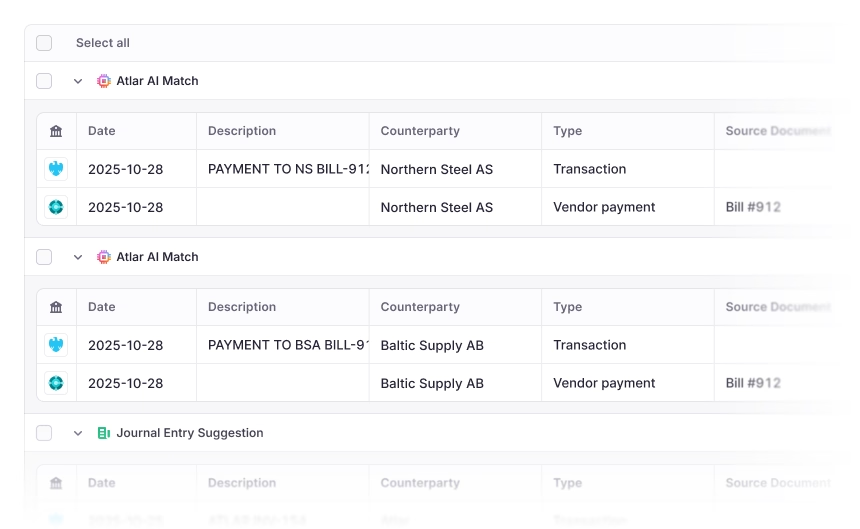
- Reconciliation: matching bank transactions to internal records and surfacing the exceptions that need a person, rather than the ones that clearly match.
- Monitoring and alerting: watching activity against policy or thresholds, such as a balance breaching a limit or a counterparty exposure moving, and flagging it when it happens rather than at the next review.
The unifying thread is that each is recurring work where the value is in catching what matters and surfacing it quickly, while the decision stays with the team.
How Atlar uses AI agents in treasury
Atlar runs AI agents on your live treasury data. The connections to your banks and ERP are built and managed by Atlar, so the agents work from current balances and transactions rather than exported or stale figures. It is the approach that led AI-first companies like Lovable and Trustly to choose Atlar.
The agents take on recurring operational work and present their output for you to review, across cash positioning, payments, reconciliation, and forecasting. Access is governed by your existing user permissions and role-based controls, so nothing happens until your team approves it, and you can reach your data from inside Claude.
Atlar is the top-rated treasury platform on G2, rated 4.8 on average across 60+ reviews. To see how Atlar's agents work, see Atlar Intelligence, or book a demo with our team.
You can unsubscribe anytime.
Further reading
See Atlar in action.
Enter your work email to watch a live product demo.