What is human-in-the-loop AI?
Human-in-the-loop AI is a way of building AI systems that keeps a person involved in the decisions, so the system recommends, drafts, or flags, and a human reviews, corrects, or approves before the outcome takes effect.
Introduction to human-in-the-loop AI
Human-in-the-loop AI describes any setup where human judgment is built into how an AI system works, rather than the system running entirely on its own. The person might label the data a model learns from, check its outputs during testing, or sign off on an action once the system is live. What these have in common is a deliberate point where a human can guide, validate, or override what the AI does.
The idea matters because automation and judgment have different strengths. A model can process far more data far faster than a person, but it can also be confidently wrong on an unfamiliar case, miss context a person would catch, or carry bias from its training data. Keeping a human in the loop is a way to get the speed of automation while holding on to the judgment, accountability, and ethical reasoning that people provide.
The term is closely tied to AI agents and agentic AI, because the more a system can act on its own, the more it matters where a person sits in relation to those actions. But human-in-the-loop is broader than agents, applying anywhere AI is built or run.
Where the human sits in the loop
"In the loop" can mean different things depending on where in an AI system's life the person is involved.
- During development: people curate and label the data a model learns from, and review its outputs during testing and tuning. The quality of this human input shapes how well the model performs once deployed.
- During operation: once a system is live, a person reviews or approves what it produces. This can run from approving every individual action to spot-checking a sample, depending on the stakes.
A related distinction describes how tight that involvement is.
- Human-in-the-loop: the system waits for a person to approve or reject before it acts.
- Human-on-the-loop: the system can act on its own, but a person monitors it and can step in.
- Human-out-of-the-loop: the system runs fully autonomously, with no routine human involvement.
The right choice depends on how costly a wrong action would be and how quickly it would need to be caught.
Why human-in-the-loop matters
Three reasons recur across the settings where this approach is used.
- Accuracy on hard cases: models handle routine inputs well but struggle with ambiguity, edge cases, and situations unlike their training data. A person can catch the errors a model is most likely to make and least likely to flag.
- Accountability: when a human approves or overrides an output, responsibility for the decision sits with a person rather than resting on the model alone. This matters for decisions that carry legal, financial, or ethical weight.
- Trust and compliance: human oversight makes an AI system more transparent and easier to justify to regulators, auditors, and the people affected by its decisions. In some settings it is now expected by law: regulation such as the EU AI Act requires that AI used in high-risk applications be designed so people can oversee it, understand its output, and intervene or stop it when needed. How much oversight is appropriate, and whether a person must approve actions in advance, depends on the use case and the level of risk.
The trade-offs
Keeping a person in the loop is not free. It adds time and cost, and it limits how far a process can scale, since human review cannot expand as cheaply as compute. The harder problem is calibration. Ask for approval on too much and reviewers face a flood of low-value alerts, which leads to fatigue and rubber-stamping, the opposite of real oversight. Ask for too little and the system can act unchecked where it should not. Effective human-in-the-loop design puts human attention at the points that genuinely need it, with enough context for the person to make a real judgment, and leaves the rest to the system.
Human-in-the-loop AI in finance
Finance is one of the clearest cases for keeping a person in the loop, because many of its actions move money or commit the business and are hard to reverse once done. AI can prepare the work, drafting a payment, assembling a position, flagging an exposure, but a person approves before anything settles. The aim is to let the system absorb the repetitive preparation while the team keeps control of the decisions that carry risk, which is also how AI agents in treasury are typically run.
How Atlar uses human-in-the-loop AI
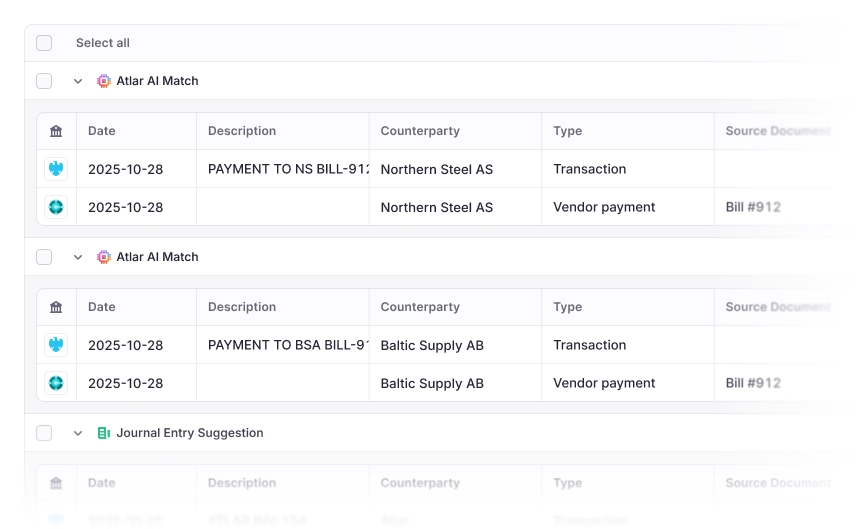
Atlar's agents do the work and present the output for you to review. An agent assembles the daily cash position, flags exceptions in a payment run, or updates a forecast on its own, and a person approves, edits, or acts on it from there, so anything that moves money or changes a record stays a human decision. The connections to your banks and ERP are built and managed by Atlar, so what the agent puts in front of you reflects current balances and transactions rather than exported or stale figures.
Access is governed by your existing user permissions and role-based controls, so an agent only ever sees what a user is allowed to, and you can reach the same data from inside Claude.
Companies like Lovable and Trustly run their treasury on Atlar, the top-rated treasury platform on G2, rated 4.8 on average across 60+ reviews. To see how Atlar's agents work, see Atlar Intelligence, or book a demo with our team.
You can unsubscribe anytime.
Further reading
See Atlar in action.
Enter your work email to watch a live product demo.