What is agentic AI?
Agentic AI is artificial intelligence built to act with agency, meaning that given a goal it decides for itself what to do to reach it, rather than waiting to be told each step.
Introduction to agentic AI
The word "agentic" points to agency, the capacity to act on one's own initiative. Agentic AI is the approach of building software that has some measure of that. You give it an outcome to achieve, and it works out and carries out the steps, drawing on tools and data and adjusting as it goes.
The useful way to think about "agentic" is as a matter of degree, not a yes-or-no label. A system is more agentic the more it can pursue a complex goal across a changing environment with little supervision, and most systems in use sit somewhere along that range, with a person setting the goal and reviewing the result.
The systems that carry out this behaviour are usually called AI agents. Put simply, an AI agent is the system, while agentic AI is the broader approach. The two terms are often used interchangeably, and the boundary between them is not fixed across the industry. Some use "agentic AI" more narrowly still, for systems where several agents coordinate on a shared goal rather than one agent working alone.
How agentic differs from automation you already have
Most software already automates work, so the question is what "agentic" adds. The dividing line is who decides the steps.
In conventional automation, a person sets the steps in advance and the software follows that path every time, which is predictable and well suited to tasks that can be fully mapped out. The more agentic a system is, the more of that step-by-step decision-making moves from the person to the system, so you specify the goal and the boundaries and it determines how to get there. That shift is what makes agentic systems useful for open-ended work that cannot be scripted ahead of time, and also what makes them less predictable than a fixed process.
Two qualities mark how far along that line a system sits.
- Autonomy is how far it acts without being told each step, the trait the word "agentic" points to most directly.
- Adaptability is how well it copes with something it was not set up for, adjusting its approach instead of failing or carrying on regardless.
A system high on both is strongly agentic; a system low on both is closer to ordinary automation.
Oversight and the degree of autonomy
How much oversight a system needs scales with how agentic it is. A low-autonomy system that only suggests is low-risk, but the more a system acts on its own, the more a single wrong action can do before anyone notices. The usual response is to keep a person in the decision path, an approach called human-in-the-loop AI, and to bound what the system can do without sign-off. In practice that often means giving a system read-only reach over sensitive data and requiring approval before it acts, so its autonomy is widest where mistakes are cheap and narrowest where they are costly or hard to undo.
Agentic AI in finance
Finance is a natural fit for agentic systems because much of the work is rule-bound and recurring, yet still calls for judgement at the edges, which is the gap autonomy is meant to fill. A treasury task such as building a cash position or checking a day's payments has a clear goal but a path that shifts with the data, so a system that can decide its own steps suits it better than a fixed script. The constraint is the data. An agentic system is only as reliable as the figures it reasons over, and in finance those figures are usually spread across banks, portals, and ERPs, so the autonomy is worth little until that data is brought together and kept current. For where this applies across the function, see what is AI in treasury management?.
How Atlar uses agentic AI
Atlar runs AI agents on your live treasury data. The connections to your banks and ERP are built and managed by Atlar, so the agents work from current balances and transactions rather than exported or stale figures. It is the approach that led AI-first companies like Lovable and Trustly to choose Atlar.
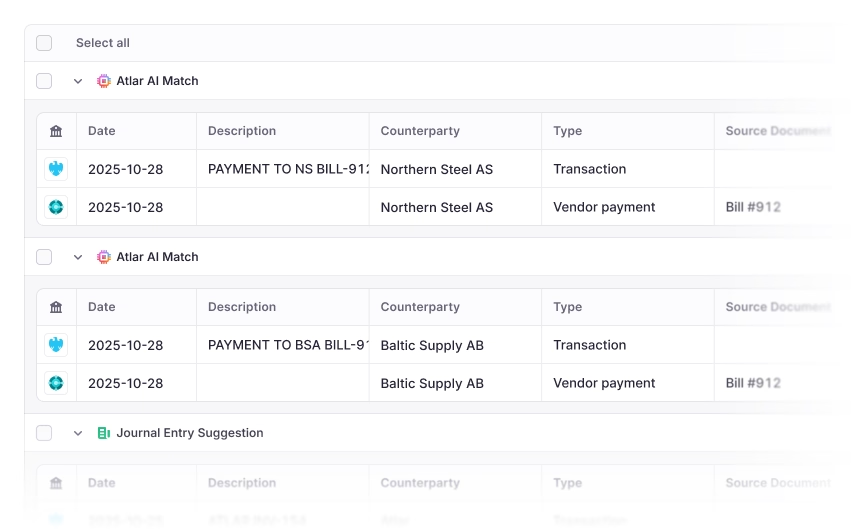
The agents take on recurring operational work and present their output for you to review, across cash positioning, payments, reconciliation, and forecasting. Access is governed by your existing user permissions and role-based controls, so nothing happens until your team approves it, and you can reach your data from inside Claude.
Atlar is the top-rated treasury platform on G2, rated 4.8 on average across 60+ reviews. To see how Atlar's agents work, see Atlar Intelligence, or book a demo with our team.
You can unsubscribe anytime.
Further reading
See Atlar in action.
Enter your work email to watch a live product demo.