What is AI in treasury management?
AI in treasury management is the use of artificial intelligence across treasury work, from forecasting cash and spotting anomalies to preparing reports and reviewing payments, to make the function faster and less manual.
Introduction to AI in treasury management
AI in treasury management is not a single product but a set of capabilities applied across the treasury function. Rather than one tool, it describes AI brought in at different points in the work, wherever a task is repetitive, data-heavy, or hard to keep current by hand.
The reason the topic has moved up the agenda is that treasury runs on data that is fragmented and time-sensitive, which is the kind of problem AI is suited to once the data is in order. Most platforms now market some form of AI, so for a treasury team the practical question is less whether to use it and more which uses are genuinely built for the work.
Where AI can be applied in treasury
AI shows up across most of the operational areas of treasury. The most common are below.
- Cash forecasting: predicting where cash will be across future horizons, learning from past patterns and refreshing as conditions change. This is one of the most established uses, covered in AI cash forecasting.
- Cash visibility: consolidating balances across accounts and entities into a current view, and presenting the cash position without manual gathering.
- Liquidity and investments: analysing where cash sits across accounts and entities to reduce idle balances, and assessing options for placing surplus cash within policy limits.
- Payments: reviewing a payment run for failures, items stuck in approval, and unusual amounts, and surfacing what needs attention before money moves.
- Fraud and anomaly detection: learning what normal activity looks like for a business and flagging transactions that deviate from it, which catches patterns that fixed rules miss.
- FX and risk: modelling currency and interest-rate exposure and surfacing it as conditions change, so hedging and funding decisions can be made on a current picture rather than a point-in-time snapshot.
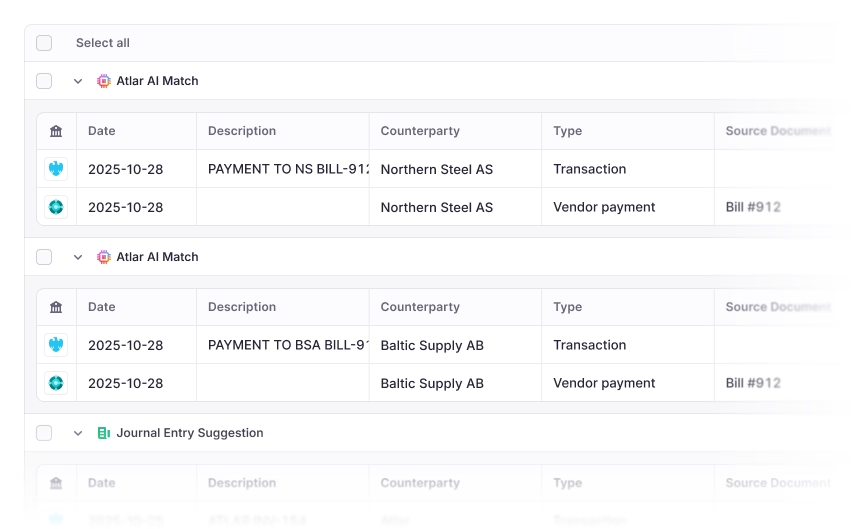
- Reconciliation: comparing what the bank reports against what the books say and isolating the items that do not line up, the subject of bank reconciliation.
- Reporting: assembling recurring treasury reports from unified data instead of compiling them by hand.
These overlap with the broader idea of treasury automation, the difference being that AI can reason over data and handle ambiguity, where older automation follows fixed rules.
Why data quality decides the outcome
Across all of these, the limiting factor is rarely the model. It is the data underneath. In most companies treasury information is scattered across banking portals, payment tools, and accounting systems, and what reaches a report is frequently already stale. Point any AI at incomplete or out-of-date figures and the output inherits those flaws, however sophisticated the model. So the groundwork for AI in treasury is getting the data right first, through bank connectivity and ERP integration that pull everything into one live source the AI can then work from.
Governance and oversight
Because treasury decisions move money and commit the business, AI used here is held to a higher standard than in lower-stakes settings. A recommendation a person cannot trace back to real data is hard to defend to a board or an auditor, so explainability, auditability, and clear human control tend to be treated as requirements rather than extras. This is also the direction of regulation and industry guidance, which increasingly expect documented oversight of AI used in financial decisions. The practical implication is that using AI does not move responsibility onto the model. Accountability still sits with the team, which is why oversight is built into how AI is applied in treasury rather than added afterwards.
From analysis to action
Early AI in treasury mostly analysed and predicted, leaving a person to act on what it found. The more recent shift is toward systems that also carry out the work, taking on a recurring task end to end and presenting the result for review. These are usually built as AI agents in treasury, which run to a goal on a schedule and surface what needs attention, with a person approving anything that moves money. The two modes are complementary: analysis informs a decision, while an agent prepares the work and brings a person in to approve it.
How Atlar uses AI in treasury management
Atlar provides an AI assistant you can ask and AI agents that do the work. The assistant answers questions of your live treasury data, querying balances, flows, and transactions and explaining what is driving them, while the agents take on recurring work, assembling the daily cash position or surfacing payment anomalies before anyone asks, and presenting the result for you to review. The connections to your banks and ERP are built and managed by Atlar, so both work from current balances and transactions rather than exported or stale figures.
Access is governed by your existing user permissions and role-based controls, and you can reach the same data from inside Claude.
Companies like Lovable and Trustly run their treasury on Atlar, the top-rated treasury platform on G2, rated 4.8 on average across 60+ reviews. To see how Atlar's AI works, see Atlar Intelligence, or book a demo with our team.
You can unsubscribe anytime.
Further reading
See Atlar in action.
Enter your work email to watch a live product demo.