Key takeaways
- SWIFT was created in 1973, standardizing electronic payment instructions and bank statements, and VisiCalc, the first spreadsheet, launched in 1979 and helped turn the PC into a finance workstation.
- SAP began when former IBM engineers stored payroll and accounting data electronically instead of on punch cards, structuring the ERP around the general ledger that companies then found hard to leave.
- Larry Ellison released Oracle Database in 1979, with the CIA as its first customer; the ERP market later consolidated around Oracle, SAP, and Microsoft, including Oracle’s acquisition of NetSuite.
- Treasury management systems emerged from the late 1980s with electronic file exchange to banks; many are still installed on local servers, maintained by internal IT, and upgraded annually, so most non-enterprise firms stayed on spreadsheets.
- Cloud delivery in the late 2000s enabled browser-based access, and web APIs in the 2010s made instantaneous data sharing possible, in contrast to 1980s batch file transfer, alongside schemes such as Faster Payments, SCT Inst, and FedNow.
Money makes the world go round, so the saying goes, and as far as businesses are concerned that’s certainly true. How this money is managed – how it’s sent, received, reported, analyzed, and secured – has changed dramatically in a short time.
For most of the twentieth century, money was managed with a pen and paper similar to the way it had been for hundreds of years. Transactions were recorded in a physical ledger, bank statements were sent in the mail, and payments were executed in person or over the phone. Bookkeeping was considered a sophisticated craft that required expertise – and lots of time.
The rise of modern finance in the 1970s
This all started to change in the early 1970s with the emergence of the modern banking system, signified by the creation of the Swift network in 1973. Bank transactions were gradually standardized and digitalized, making it possible to send payment instructions and receive bank statements electronically.
A few years later, in 1979, a software program was released for the Apple II computer that would transcend the system it was designed for and even precipitate Apple’s decline in the 1980s. VisiCalc, literally the “visible calculator”, was the world’s first spreadsheet program and turned the PC from a hobby tool into a workstation almost overnight. Within two years of its release, the first IBM PC appeared and corporate boardrooms would never look back.
By the mid-1980s, thanks to Swift and spreadsheets, finance had entered the digital age with physical ledgers and books replaced by software, simplifying the act of managing money, recording transactions, and creating reports.
ERPs and the battle for the general ledger
Spreadsheets were just the beginning. When a group of IBM engineers from a small German town had their database project canceled, they left to start a new company called ‘Systemanalyse und Programmentwicklung’. Later shortened to SAP, the company’s first program stored payroll and accounting information electronically instead of on mechanical punch cards, as IBM did, and the ERP (Enterprise Resource Planning) system was born.
Early ERP systems were built around what’s called a general ledger: a bookkeeping tool where financial information such as accounts payable (money owed to suppliers), accounts receivable (money owed by customers), cash balances, and assets are recorded and aggregated.
Structuring ERPs this way turned out to be a smart move. Once a company came to rely on this ledger to understand and manage its financial position, it became locked into the ERP system and found it difficult to switch – a phenomenon still very much in force to this day. Still, with an ERP installed now even the largest, most complex enterprises could join the digital age.
It was around this time that a 33-year-old computer programmer named Larry Ellison started working on a database for the CIA that he nicknamed ‘Oracle’. Having grasped the size of the opportunity in business software, Ellison released the Oracle Database in 1979, marking the start of the battle for the general ledger (detailed in his biography, Softwar). Incidentally, the CIA was Oracle’s first customer.
The struggle to dominate the nascent ERP market continued into the 2000s, culminating to some extent in Oracle’s acquisition of NetSuite. Since then the dust has settled, and market leaders Oracle, SAP, and Microsoft have maintained their dominant positions up to the present.
The TMS catches an industry off-guard
As ERP companies were bunkering down in the 1980s to win the battle for the general ledger, they missed the war about to take place over where and how companies actually manage money. This left an opening for a new type of software to emerge: the so-called ‘treasury management system’ (TMS).
Leveraging Swift's growing adoption among banks, the TMS replaced spreadsheets with purpose-built software for the corporate treasury from the late 1980s onwards. The key innovation of the TMS was a file exchange service, still in place across many incumbent systems today, that let businesses send and receive information with their banks electronically instead of through physical documents.
Soon, large enterprises were hiring teams of IT specialists to install these standalone machines in the corner of their treasury departments. Given the resources it took to implement them, though, most non-enterprise businesses stuck to their spreadsheets. Even today, it’s still common for TMS software to be installed locally on a company’s servers, maintained by internal IT staff, and updated on an annual basis in the form of dreaded system-wide upgrades.
Over the course of the 1990s, the TMS evolved into a highly sophisticated, elaborate piece of software – even if there was no real paradigm shift in innovation. These systems did, however, integrate the new 90s-era robotic process automation (RPA) technology, introducing software robots, or bots, to automate repetitive tasks like data collection and payment processing.

Enter the ‘cloud’ and APIs
It took the arrival of cloud technology in the late 2000s to spark a new wave of entrants into the world of money management. Now, for the first time, businesses could access financial data and manage money remotely inside a web browser. Even so, while this opened up a new SaaS-based delivery model, the underlying technology of a TMS remained the same.
Innovation really gathered pace in the 2010s with the rise of web APIs. As a means of communication between software programs, APIs increased the interoperability of different systems and, as banks started to adopt them, instantaneous data sharing became possible for the first time – in stark contrast to the file-based ‘batch transfer’ that originated in the 1980s.
The proliferation of financial APIs enabled another leap forward: that of real-time financial data and payments. Faster Payments in the UK, the EU’s SCT Inst, and FedNow in the US are all products of this trend, unlocking new functionality like continuous reconciliation and instant payment confirmation. Manually logging transactions in a spreadsheet and transferring files between systems already feel antiquated by comparison.
How modern teams manage money
These latest infrastructure upgrades represent a bigger shift in treasury technology than perhaps at any time since the earliest computer programs. Money can now flow in real time, no longer held back by batch processing delays, legacy systems, and fundamentally manual processes like those of Swift connections and the TMS.
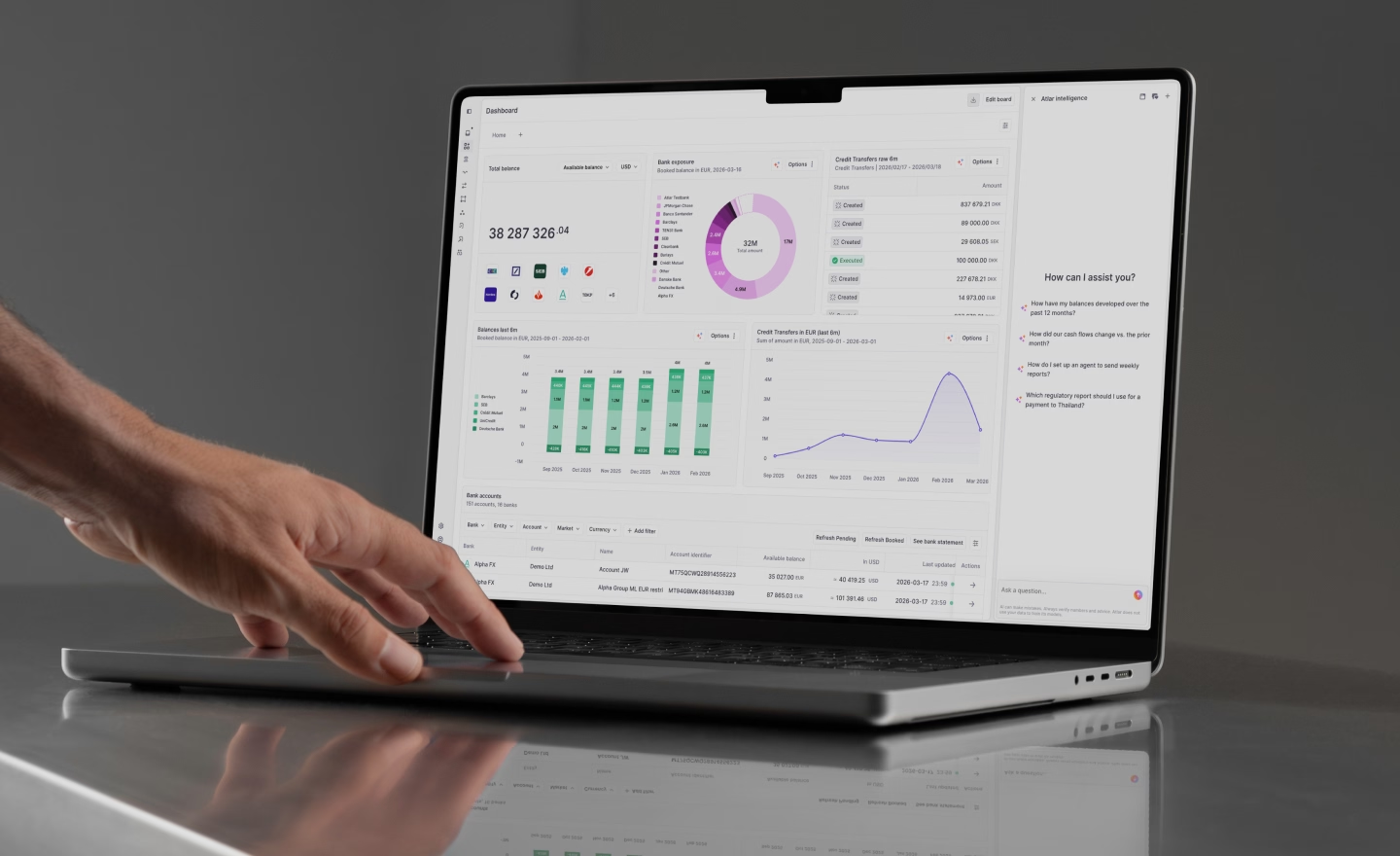
This paradigm shift is what called Atlar onto the stage and is at the core of how we help our customers manage money.
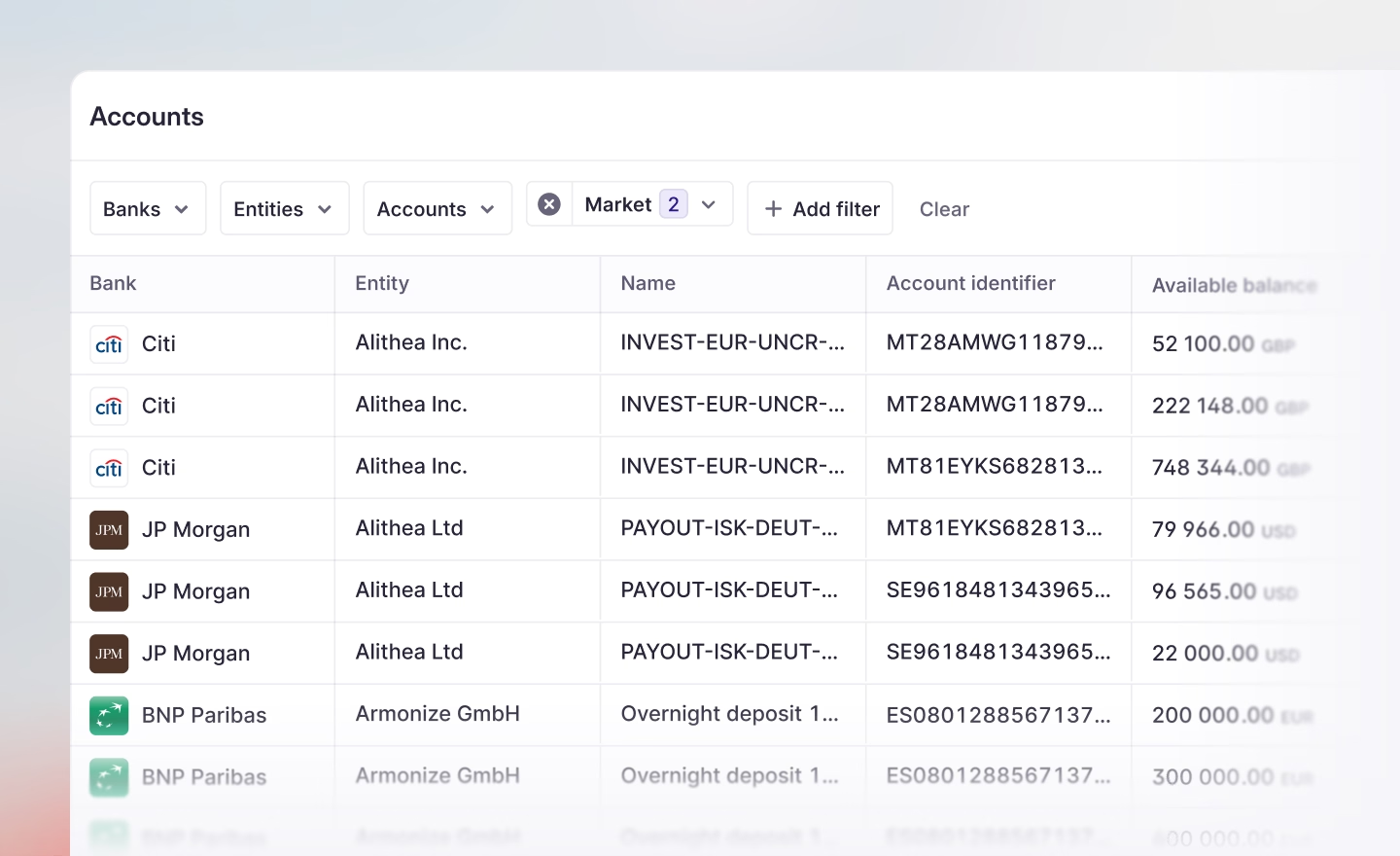
If you’re interested in seeing what modern finance tooling looks like, get in touch.