What is treasury automation?
Treasury automation is the use of software to run treasury tasks that a team would otherwise do by hand, such as gathering balances, routing payments for approval, and matching transactions, so the work happens faster and with fewer errors.
Introduction to treasury automation
Treasury automation covers any technology that takes a manual treasury process and runs it without a person doing each step. Traditionally this has meant rule-based workflows: a set of instructions the software follows the same way every time, such as importing bank statements each morning, flagging any payment above a threshold, or posting a matched transaction to the ledger. Where a process is well-defined and repeats, a rule can carry it out.
A common form is robotic process automation, or RPA, where a software routine copies the steps a person would take across different systems, such as logging into a bank portal, downloading a file, and entering the figures into a spreadsheet or ERP. RPA sits on top of existing systems and mimics the manual actions, which makes it useful for connecting tools that were never designed to talk to each other.
The point of automating this work is not to remove the treasury team but to take the repetitive, error-prone parts off their plate, so a small team can spend its time on judgment calls instead of manual collection and routine checks.
Where treasury automation is used
Automation applies across most of the recurring work in treasury. Common examples include:
- Cash positioning: gathering balances from connected accounts and compiling the daily cash position without manual collection.
- Payments: routing a payment for approval, running checks against set thresholds, and executing it once approved.
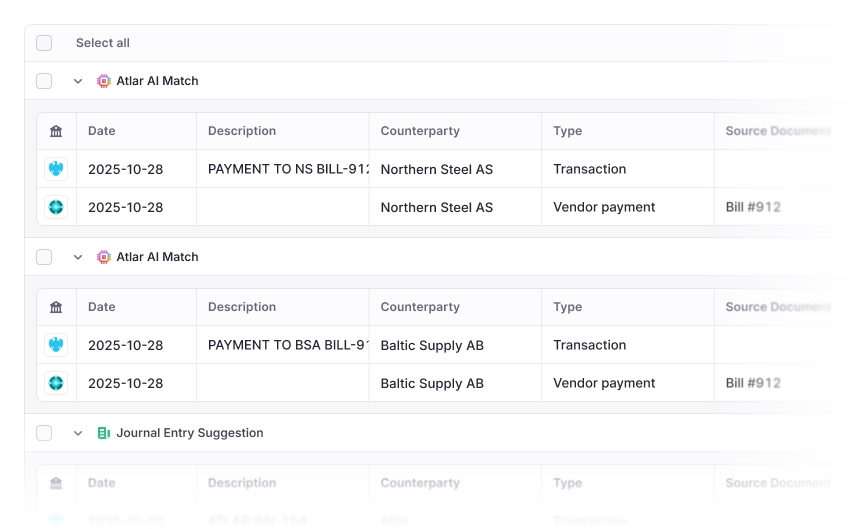
- Reconciliation: matching bank transactions to internal records under set rules and holding back the ones that do not match for review, a core part of bank reconciliation.
- Forecasting: pulling the inputs for a cash flow forecast together automatically so the projection is not rebuilt by hand each time.
- Reporting: compiling recurring treasury reports from consolidated data on a set schedule.
What automation depends on and delivers
Automation only works if the data it runs on is flowing. Because treasury data sits across bank portals, payment systems, and ERPs, the groundwork for automating any of the tasks above is the connection to those systems, through direct bank connectivity and ERP integration that keep balances and transactions moving without manual collection. RPA grew up as a way to bridge systems that were never built to connect, and a platform built to connect them directly removes much of that manual bridging in the first place.
Beyond saving time, automation adds control. A rule runs the same way every time, which makes the process consistent and leaves a record of what happened and when. Approvals follow a set path, thresholds are applied uniformly, and each step is logged, which supports the audit trail and policy compliance treasury teams are accountable for.
The limits of rule-based automation
Rule-based automation is reliable for work that fits a fixed pattern, but it stops where the pattern does. A rule can flag a payment that is larger than usual, but it cannot tell whether the difference is a genuine problem or an expected one, such as a supplier payment that is higher this month for a known reason. It quarantines the exception and waits for a person to decide.
This is the ceiling that separates automation from AI. Rules execute; they do not interpret. As treasury data and decisions grow more complex, teams increasingly pair rule-based automation with AI that can reason over the data, weigh context, and handle the ambiguous cases rules cannot. This is the wider shift covered in AI in treasury management, and its most recent form is AI agents in treasury, which carry out a whole task and bring a person in to approve the outcome.
How Atlar automates treasury operations
Atlar automates the day-to-day running of treasury, from payment operations and approval chains to sweeping rules and reconciliation, all on data that flows in automatically. The connections to your banks and ERP are built and managed by Atlar, so the platform works from current balances and transactions rather than exported or stale figures, and its depth on NetSuite was recognized with NetSuite's 2025 SuiteCloud International Partner of the Year award.
On top of that, Atlar's AI agents take on recurring operational work, like assembling the daily cash position or surfacing payment anomalies and presenting the result for you to review. Access follows your existing user permissions and role-based controls, so nothing happens until your team approves it, and you can reach the same data from inside Claude.
Companies like Mangopay, Tide, GetYourGuide, Acne Studios, Lovable, and Trustly run their treasury on Atlar, the top-rated treasury platform on G2, rated 4.8 on average across 60+ reviews. To see how Atlar automates treasury, explore the platform, or book a demo with our team.
You can unsubscribe anytime.
Further reading
See Atlar in action.
Enter your work email to watch a live product demo.