Key takeaways
- Atlar's Model Context Protocol (MCP) connector now gives Claude access to reconciliation, forecast accuracy, debt schedules, benchmark rates, bank connections, users, and scheduled reports, alongside accounts, balances, transactions, and forecasts.
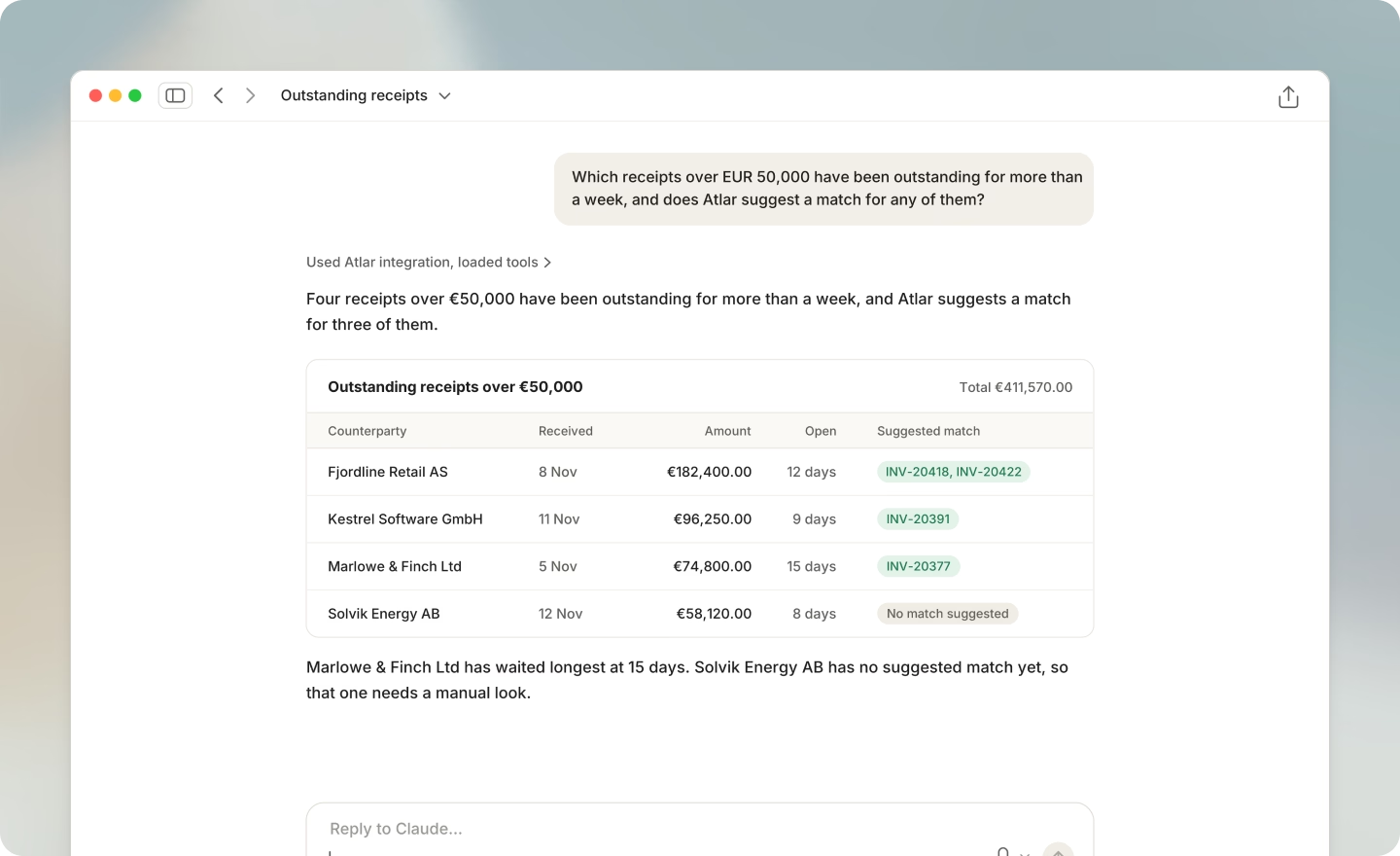
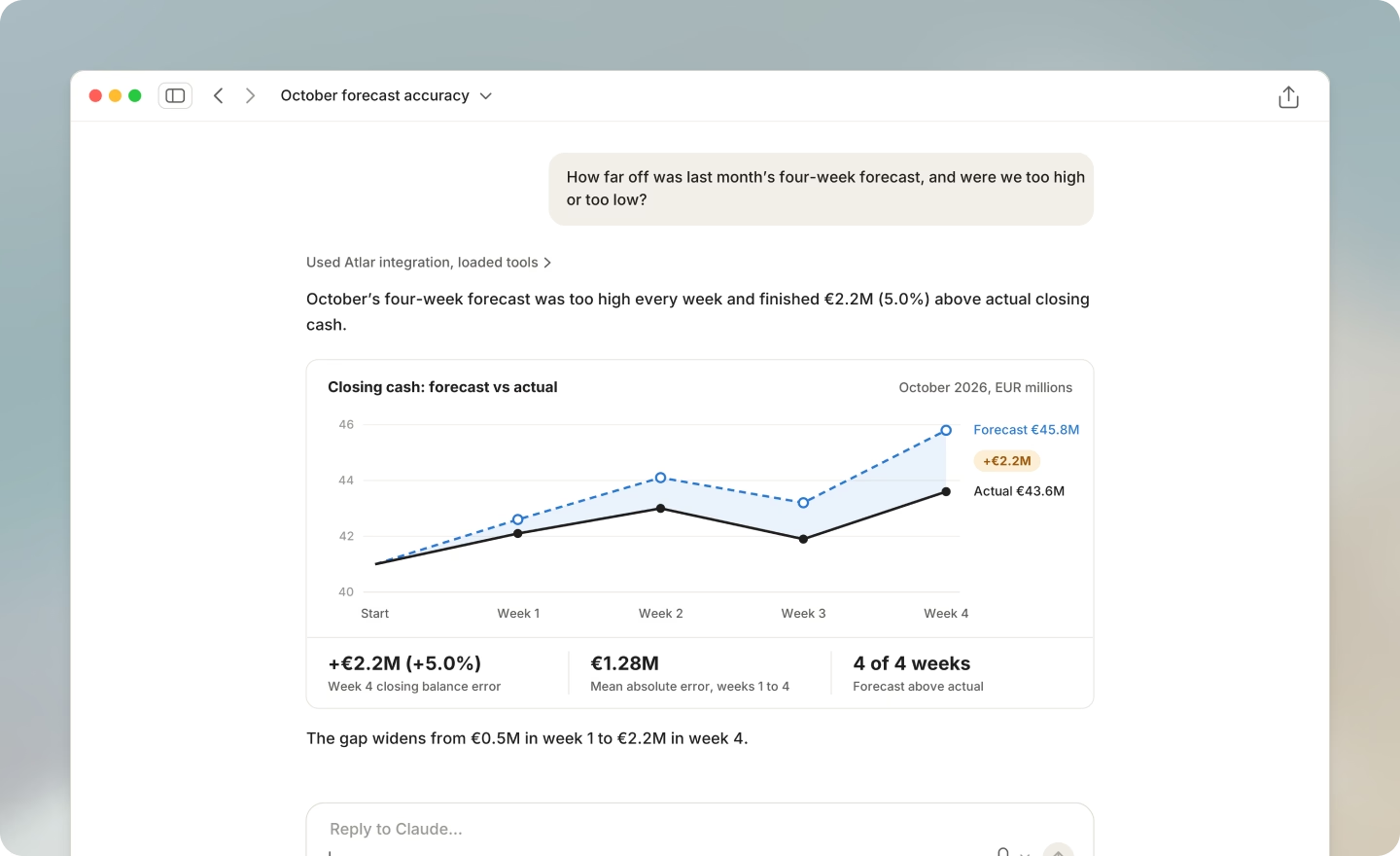
- Claude can show which receipts are still outstanding and what Atlar suggests matching them to, how close last month's forecast came to actuals, and the next interest payment on a floating-rate facility.
- The new lookups are read-only and run with the connected user's role, an admin decides whether the connector can also take actions, and every query is logged in Atlar's audit trail.
- The MCP connector is one of three ways to use AI with Atlar, alongside agentic workflows for recurring work and Ask Atlar for ad-hoc questions inside the platform.
- Read access and write actions will keep expanding, while approving payments stays with people by design.
Through Atlar's Model Context Protocol (MCP) connector, Claude can now see much more of the platform. Alongside accounts, balances, transactions, and forecasts, it can read reconciliation, forecast accuracy, debt schedules, benchmark rates, bank connections, users, and scheduled reports.
Finance teams use the connector for much more than looking up balances. Storytel's treasury manager, for example, builds the company's monthly treasury report in Claude from live Atlar data.
Reconciliation, forecasting, and debt
Claude can see reconciliation matches, suggested matches, and outstanding transactions, along with the rules and configurations behind them. Ask why a payment is still outstanding or which invoices a receipt was matched to, and the answer comes from the same reconciliation your accounting team works in.
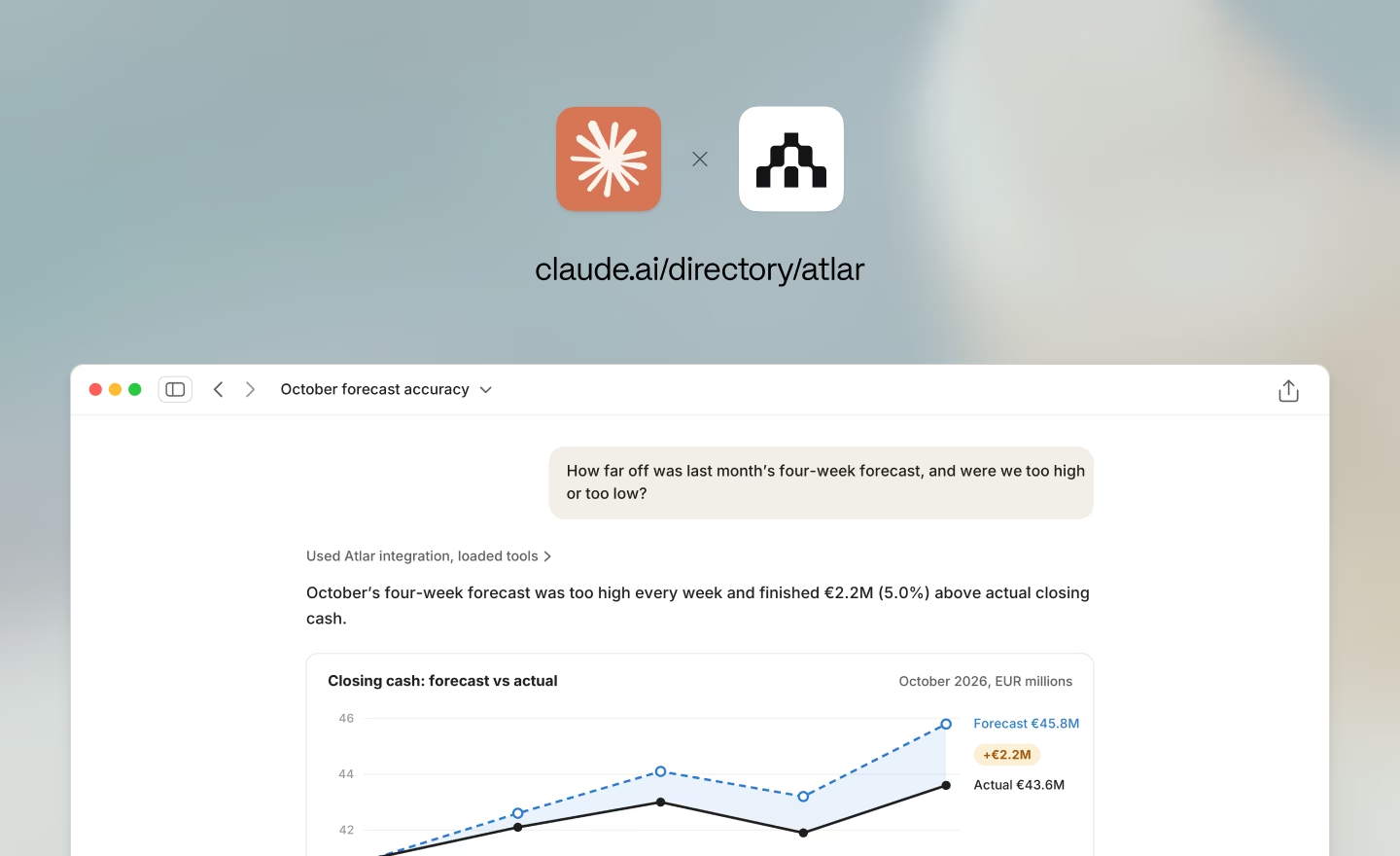
Forecast configurations and backtesting results show Claude how close last month's forecast came to actuals, and in which weeks it drifted.
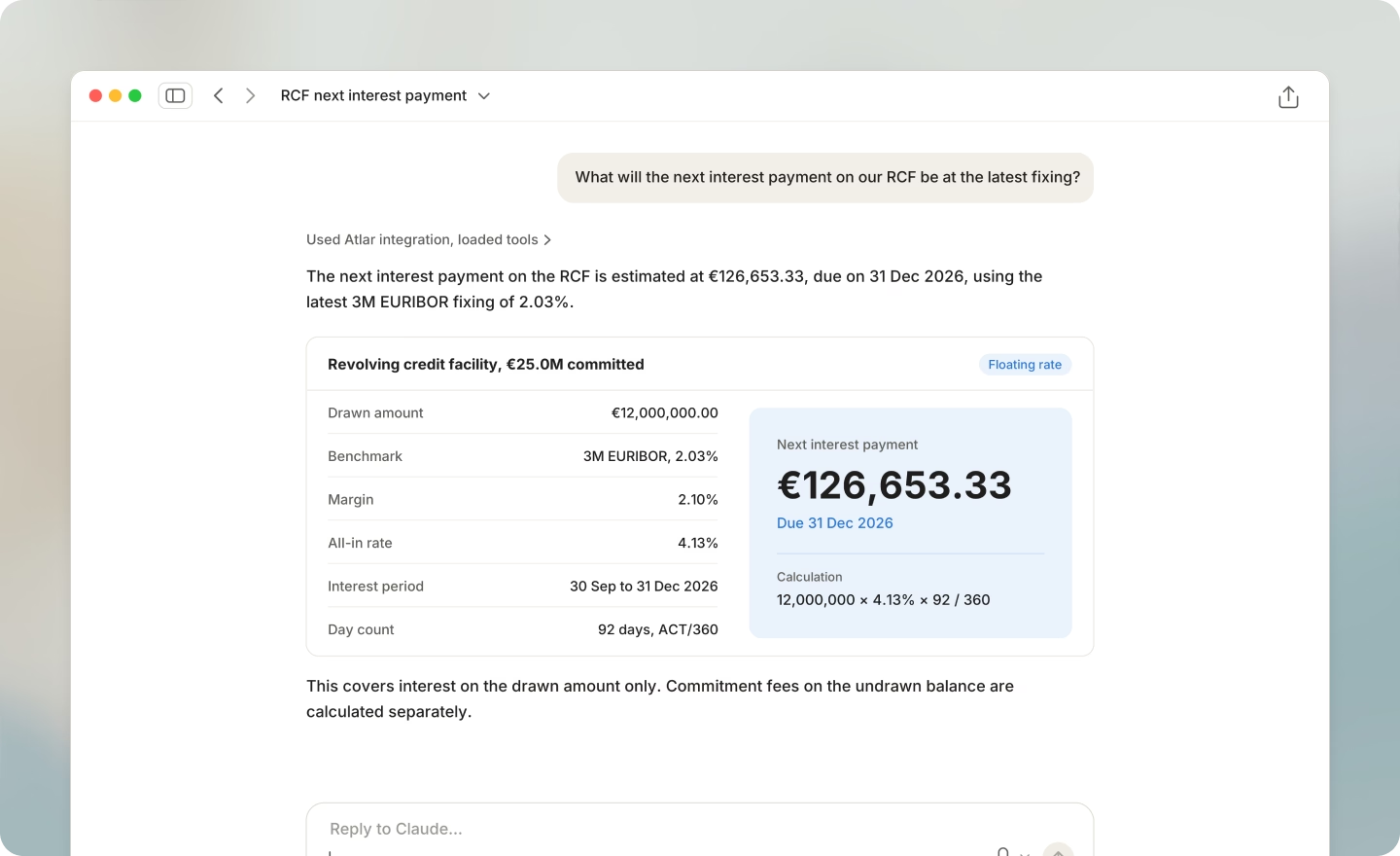
For debt, Claude pulls loan and facility settlements alongside benchmark rates and fixings such as EURIBOR and SOFR, and can work out the next interest payment on a floating-rate facility.
The connector also covers entities, pending transactions, direct debit batches, GL accounts, vendor bank accounts, bank connections, users and invitations, scheduled reports, and your own notifications.
Why coverage matters
An AI model can only answer well when it can see everything the answer depends on. Today's cash position needs balances. Explaining why the position moved needs pending transactions, reconciliation, and the forecast it was measured against. Every area Claude can't reach sends someone back to a dashboard or a spreadsheet export, and the conversation stops there.
We've argued before that models are rarely the bottleneck in finance, and that the data and tools around them decide what's possible. In Atlar, that data comes from bank connections we build and maintain ourselves, across banks in over 100 countries. It's standardized before Claude sees any of it.
The same controls as the dashboard
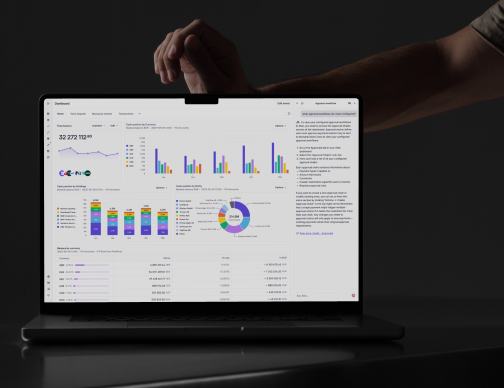
The new lookups are read-only. They run as the user who connected Claude, with that user's role. Claude can't see anything the role can't see in Atlar, an admin decides whether the connector can only read or also take actions, and every query is recorded in Atlar's audit trail. Customer data is never used to train external models.
Three ways to use AI with Atlar
The MCP connector is one of three ways finance teams work with AI in Atlar, and each suits a different kind of work.
- Agentic workflows run recurring work on a schedule, such as a daily cash report checked against treasury policy or a morning review of upcoming rate resets and maturities. Each workflow recommends actions for someone to approve.
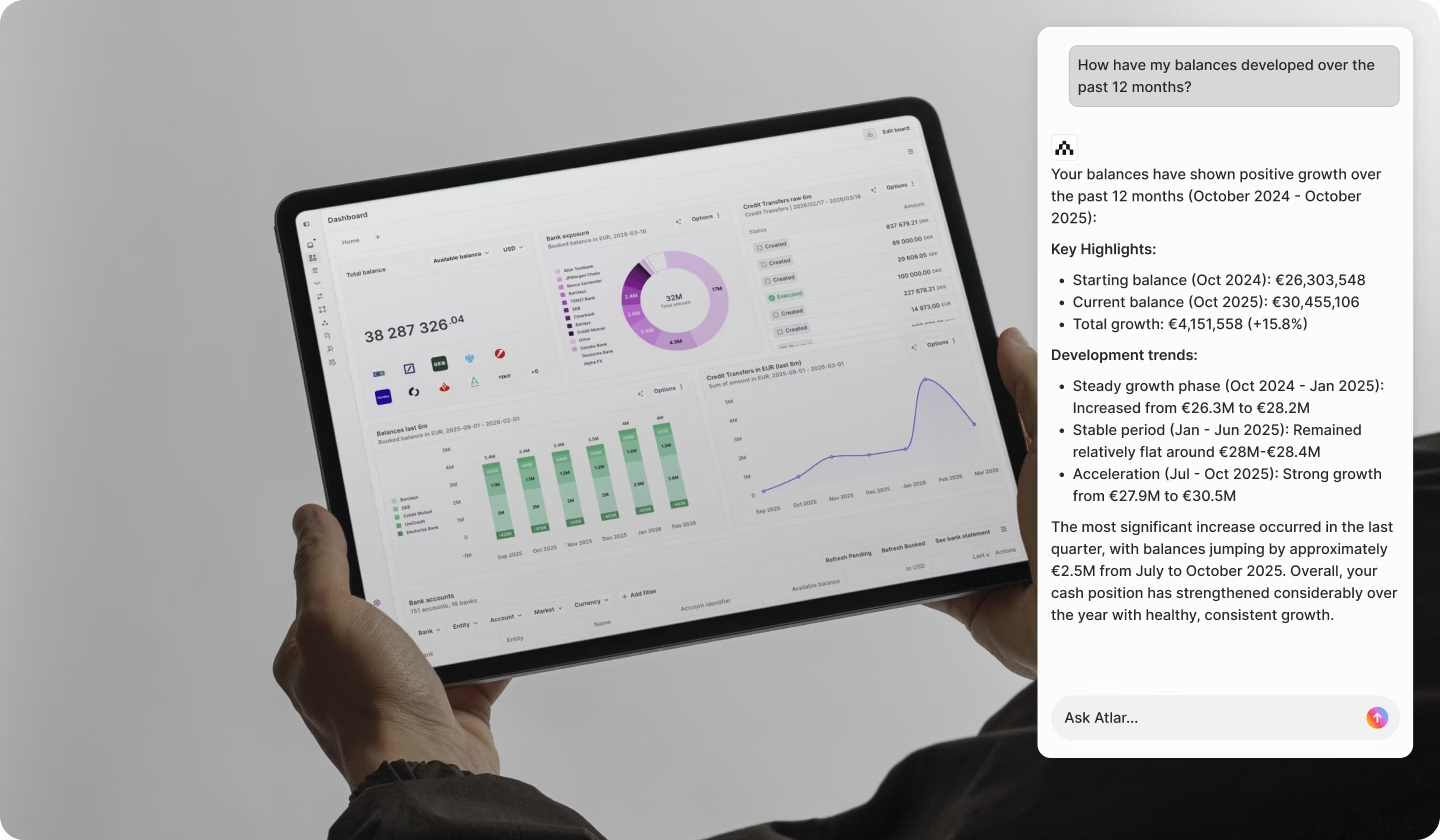
- Ask Atlar, the assistant built into the platform, handles ad-hoc questions and simple actions, such as how balances have developed over the past year or drafting a loan facility from an uploaded agreement.
- The MCP connector brings Atlar into the AI tools teams already work in, such as Claude and ChatGPT, where treasury data sits next to their documents and other connected apps.
What comes next
Read access will keep expanding, with the approvals queue, payment audit trails, and receivables and payables aging next. Claude will also take on more of the work itself, such as logging loan and facility activity, uploading forecast estimates in bulk, and updating forecast structures. All of it will go through the same permissions and approval chains. Approving payments will stay with people, by design. Admins will also be able to approve other AI tools their teams use, beyond Claude and ChatGPT.
Getting started with Atlar's MCP connector
Atlar is listed in Claude's directory, and teams can connect a demo account before their own. The setup guide covers admin settings and access levels.
AI-first companies like Lovable and Parloa run treasury on Atlar, as do listed companies such as Storytel and Bandwidth. To see the connector against your own data, request a demo or get in touch with our team.